 LinkBack URL
 About LinkBacks
Y JFK. Especialmente JFK.
 ¡Bienvenido a mundodvd! Regístrate ahora y accede a todos los contenidos de la web. El registro es totalmente gratuito y obtendrás muchas ventajas.¡Bienvenido a mundodvd! Regístrate ahora y accede a todos los contenidos de la web. El registro es totalmente gratuito y obtendrás muchas ventajas.


 Re: El dia de la revelación (Disclosure Day, 2026, Steven Spielberg)
Y JFK. Especialmente JFK.
What makes Megalopolis so strange and, for a big-budget Hollywood film, so singular, is that, just like Vergil’s Aeneid, it is at once accretive, allusive, and idiosyncratic because Coppola is attempting something very few artists have ever done: to speak from inside the imperial organism, even as it begins to crack, and to craft a vision that is both a monument to its grandeur and a requiem for its decline.
 Re: El dia de la revelación (Disclosure Day, 2026, Steven Spielberg)
Es la marca del casoplón.
Re: El dia de la revelación (Disclosure Day, 2026, Steven Spielberg)
?Iniciado por Kaa

What makes Megalopolis so strange and, for a big-budget Hollywood film, so singular, is that, just like Vergil’s Aeneid, it is at once accretive, allusive, and idiosyncratic because Coppola is attempting something very few artists have ever done: to speak from inside the imperial organism, even as it begins to crack, and to craft a vision that is both a monument to its grandeur and a requiem for its decline.

 Re: El dia de la revelación (Disclosure Day, 2026, Steven Spielberg)
Suena la mar de bien, a mí me ha recordado a Delereue (que recordemos que era el compositor de cabecera de cierto director francés que salía en... Encuentros en la tercera fase)
Q: "I'm your new quartermaster"
007: "You must be joking"
_______________________
CLAUDIO: "Lady, as you are mine, I am yours"
_______________________
EISENSTEIN: "I'm a boxer for the freedom of the cinematic expression" -"I'm a scientific dilettante with encyclopedic interests"
Re: El dia de la revelación (Disclosure Day, 2026, Steven Spielberg)
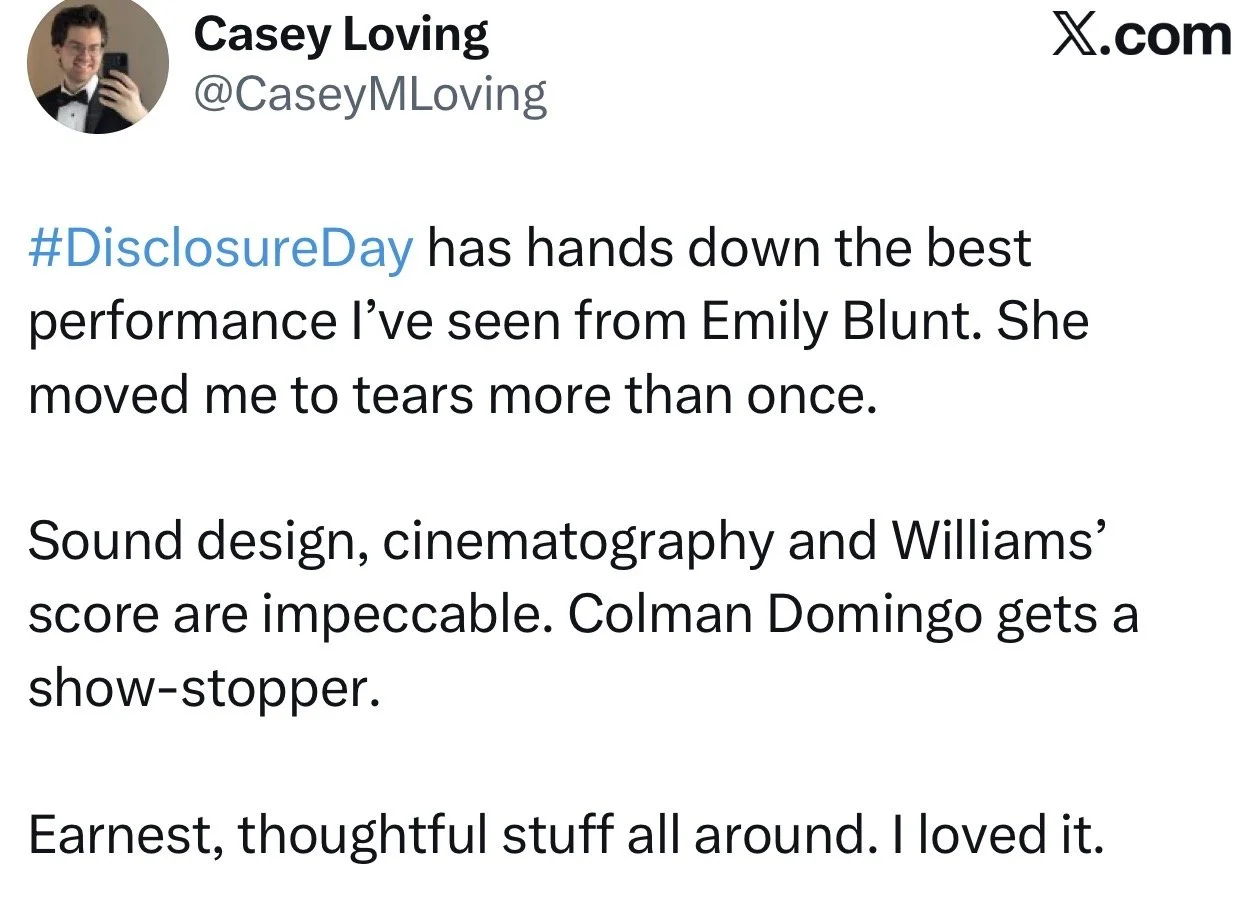
Ya le hicieron el feo a Amy Adams que ni obtuvo una mísera nominación por La llegada, Espero que no le pase lo mismo a Blunt con lo que parece otro papelón en otra película de género de ciencia-ficción.
Saludos
Q: "I'm your new quartermaster"
007: "You must be joking"
_______________________
CLAUDIO: "Lady, as you are mine, I am yours"
_______________________
EISENSTEIN: "I'm a boxer for the freedom of the cinematic expression" -"I'm a scientific dilettante with encyclopedic interests"


 Re: El dia de la revelación (Disclosure Day, 2026, Steven Spielberg)
Re: El dia de la revelación (Disclosure Day, 2026, Steven Spielberg)
Re: El dia de la revelación (Disclosure Day, 2026, Steven Spielberg)
Última edición por Branagh/Doyle; 03/06/2026 a las 20:43
What makes Megalopolis so strange and, for a big-budget Hollywood film, so singular, is that, just like Vergil’s Aeneid, it is at once accretive, allusive, and idiosyncratic because Coppola is attempting something very few artists have ever done: to speak from inside the imperial organism, even as it begins to crack, and to craft a vision that is both a monument to its grandeur and a requiem for its decline.
Re: El dia de la revelación (Disclosure Day, 2026, Steven Spielberg)
What makes Megalopolis so strange and, for a big-budget Hollywood film, so singular, is that, just like Vergil’s Aeneid, it is at once accretive, allusive, and idiosyncratic because Coppola is attempting something very few artists have ever done: to speak from inside the imperial organism, even as it begins to crack, and to craft a vision that is both a monument to its grandeur and a requiem for its decline.
Re: El dia de la revelación (Disclosure Day, 2026, Steven Spielberg)
IT BLOWS MY MIND A WHEELCHAIR-BOUND 94-YEAR-OLD CAN STILL WRITE MUSIC THAT SPURS MY EMOTIONS AND IMAGINATION!!!!!!!!!
I DONT’T GIVE A SHIT ABOUT “MUH MEMORABLE THEMES” OR HOW IT DOESN’T SOUND LIKE “THE OLD STUFF”, CRITIQUES THAT REVEAL MORE ABOUT THE ATTENTION SPAN OF THE LISTENER THAN THE QUALITY OF THE MUSIC!!!!!!!
THIS SHIT FUCKING RIPS!!!!!!!

What makes Megalopolis so strange and, for a big-budget Hollywood film, so singular, is that, just like Vergil’s Aeneid, it is at once accretive, allusive, and idiosyncratic because Coppola is attempting something very few artists have ever done: to speak from inside the imperial organism, even as it begins to crack, and to craft a vision that is both a monument to its grandeur and a requiem for its decline.
 Re: El dia de la revelación (Disclosure Day, 2026, Steven Spielberg)
Me temo lo contrario, salvo que el film contenga alecturas que les gustan a los activistas de la industria aka La Sustancia
 Re: El dia de la revelación (Disclosure Day, 2026, Steven Spielberg)
Yo no quería decir nada, era mi deseo esperar en silencio hasta escuchar más de este clip que justo se termina en lo más emocionante. Pero la ansia, ay la ansia.
En pocas palabras, suena a un poquito de War Horse con tema Anakin (como ya se ha comentado), aderezado con las manías del último Williams, pero incluso con un punto más de retorcimiento psicológico en el tratamiento de la melodía. Y esto es algo que me sorprende mucho, puesto que habíamos hablado largo y tendido que no estábamos ante un Williams melódico, sino más conceptual, más atmosférico, menos prosaico. Sin embargo, aquí tenemos nostalgia, epopeya, lirismo a raudales, un paseo sinuoso que serpentea por todo el pentagrama.... Y como el cine de Spielberg, con el filtro de los años añadiendo peso.
Pero bueno, lo dejo aquí porque sacar conclusiones de probablemente los 70 segundos probablemente más "accesibles", no es de recibo...
Re: El dia de la revelación (Disclosure Day, 2026, Steven Spielberg)
Tampoco descartes que los comentarios de gente que hemos leido describiendo estilisticamente el score sean disparates, que muchas personas tienen los oidos de corchopan (dicho con todo el cariño).
No se si has mirado en esta misma página más arriba pero ya está el corte completo disponible para escuchar (cuatro minutos).
Última edición por Branagh/Doyle; 03/06/2026 a las 22:34 Razón: Errata
What makes Megalopolis so strange and, for a big-budget Hollywood film, so singular, is that, just like Vergil’s Aeneid, it is at once accretive, allusive, and idiosyncratic because Coppola is attempting something very few artists have ever done: to speak from inside the imperial organism, even as it begins to crack, and to craft a vision that is both a monument to its grandeur and a requiem for its decline.
Re: El dia de la revelación (Disclosure Day, 2026, Steven Spielberg)
Oh, muchas gracias. Ahora sí. Es bastante impresionante todo entero, tengo que decir. Un tema principal muy alejado de los que hacía en las primeras etapas de Williams -estamos en su estilo final-, donde la desnudez, la simpleza, casi sin terminar, la tonalidad ambigua, expansiva, toma cuerpo. Incluso me atrevería a decir, por la elección de los intervalos, tiene un recordatorio, simplemente psicológico, de las 5 notas de Encuentros. O es que ya me estoy volviendo loco...
Re: El dia de la revelación (Disclosure Day, 2026, Steven Spielberg)
Ya se ha lanzado oficialmente por Back Lot Music en España:
También está disponible en Apple Music, Spotify y demás plataformas y tiendas digitales.
Última edición por Branagh/Doyle; 04/06/2026 a las 08:26
What makes Megalopolis so strange and, for a big-budget Hollywood film, so singular, is that, just like Vergil’s Aeneid, it is at once accretive, allusive, and idiosyncratic because Coppola is attempting something very few artists have ever done: to speak from inside the imperial organism, even as it begins to crack, and to craft a vision that is both a monument to its grandeur and a requiem for its decline.
Re: El dia de la revelación (Disclosure Day, 2026, Steven Spielberg)
What makes Megalopolis so strange and, for a big-budget Hollywood film, so singular, is that, just like Vergil’s Aeneid, it is at once accretive, allusive, and idiosyncratic because Coppola is attempting something very few artists have ever done: to speak from inside the imperial organism, even as it begins to crack, and to craft a vision that is both a monument to its grandeur and a requiem for its decline.
 Permisos de publicación

 Citar
Citar