
Instala la aplicación
Cómo instalar la aplicación en iOS
Sigue el vídeo para ver cómo instalar el foro como aplicación web en la pantalla de inicio.
Nota: Es posible que esta función no esté disponible en algunos navegadores.
-
Mejoras, sugerencias y cambios del foro · Consulta las novedades y comparte tus propuestas.
Estás utilizando un navegador obsoleto. Puede que este u otros sitios no se muestren correctamente.
Debes actualizarlo o utilizar un navegador alternativo.
Debes actualizarlo o utilizar un navegador alternativo.


Branagh/Doyle
Miembro23.078 mensajesdesde 2014
54.464 agradecimientos
Zimmer respondiendo a una crítica de la banda sonora de Dune en el foro Vi-Control (punto de reunión de compositores y músicos).
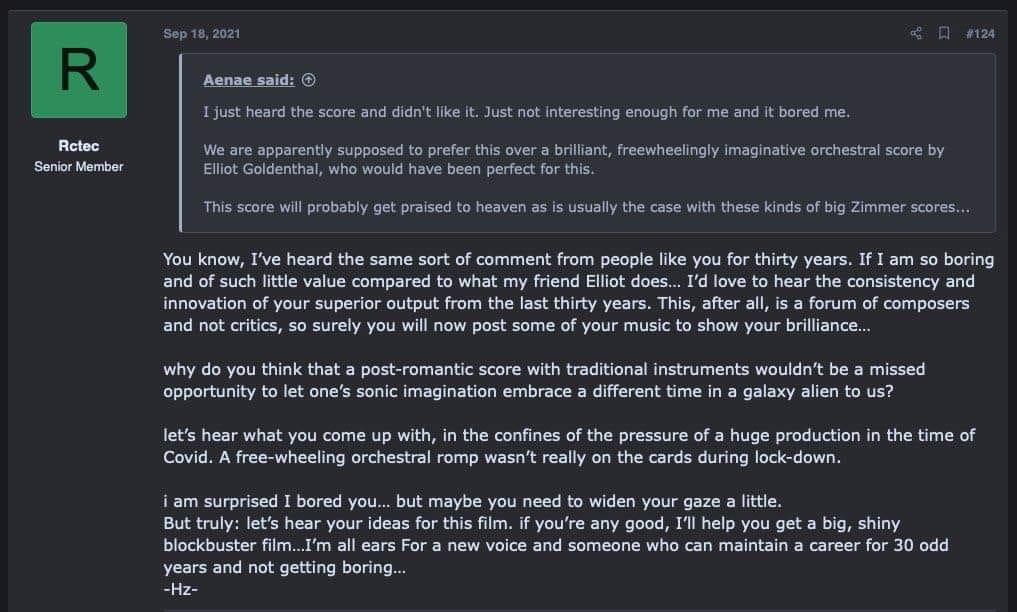
A mí me parece adecuada la respuesta, no olvidemos que los compositores son personas y también tienen su sensibilidad y corazoncito, y tiene que estar un poco cansado a estas alturas de "Elliot Goldenthal era la gran esperanza de la música de cine y tú (y tu empresa) acabaste con algo que era maravilloso".
A mí me parece adecuada la respuesta, no olvidemos que los compositores son personas y también tienen su sensibilidad y corazoncito, y tiene que estar un poco cansado a estas alturas de "Elliot Goldenthal era la gran esperanza de la música de cine y tú (y tu empresa) acabaste con algo que era maravilloso".
Última edición:

PrimeCallahan
Miembro18.943 mensajesdesde 2013
34.167 agradecimientos
Yo es que el argumento de que Zimmer se ha cargado la musica de cine, me parece tan banal y superficial... porque luego estos mismos que se llenan la boca de que Zimmer es el diablo, se las tiran a gente como Giacchino o Desplat, ojo.
O sea, que cuando Desplat ofrece un score lleno de ideas tematicas, escritura compleja y orquestaciones brillantes, es frio y carente de emociones, luego llega Zimmer y a el le dicen que es ruido, ruido..., en definitiva, a mi me parece horrible. Yo lo que quiero es variedad y capacidad narrativa en la pelicula, el masacrar gente con talento es deleznable, con franqueza, lo digo.
O sea, que cuando Desplat ofrece un score lleno de ideas tematicas, escritura compleja y orquestaciones brillantes, es frio y carente de emociones, luego llega Zimmer y a el le dicen que es ruido, ruido..., en definitiva, a mi me parece horrible. Yo lo que quiero es variedad y capacidad narrativa en la pelicula, el masacrar gente con talento es deleznable, con franqueza, lo digo.
PrimeCallahan
Miembro18.943 mensajesdesde 2013
34.167 agradecimientos
Autor muy infravalorado, Badalamenti, con excelentes obras en su haber. Y más versátil de lo que se piensa, compositivamente hablando. Tiene una formación clásica muy extensa, y sin embargo, según sus propias palabras, rara vez se le ha considerado en el audiovisual para encargos sinfónicos de enjundia.
El autor del mitico tema de Twin Peaks (y de bastantes peliculas de David Lynch)
Branagh/Doyle
Miembro23.078 mensajesdesde 2014
54.464 agradecimientos
Página for your consideration de Dune, donde se pueden escuchar gratuitamente 90 minutos de la banda sonora de Zimmer (hay más música que en el album oficial)
Alguien ha tenido la gentileza de subirlo todo a youtube, por orden.
https://www.youtube.com/playlist?list=PL-KykV_4XmWOE-otrFn4F93k_9Je0cRi2
01 1m01 Opening (3:14)
02 1m02b Herald of the Change (3:14)
03 1m04 Paul Tells Duncan His Dream (2:33)
04 2m10 Bene Gisserit Arrive (3:44)
05 2m11 Gom Jabbar (2:03)
06 2m12 Bene Gisserit Leave (2:01)
07 2m13a Paul & Jessica (1:46)
08 2m14 Leaving Caladan (1:57)
09 3m20 Sandwalk Video (1:29)
10 4m27 Flight to Spice Field (2:09)
11 4m28-29 Failed Harvester Lock (5:47)
12 4m30 Visions of Chani (4:30)
13 5m31 Sardaukar Chant (1:20)
14 5m32-35 Night On Arrakis (5:12)
15 5m36-37 Harkonnen Attack (2:41)
16 5m38-39 Betrayal (2:41)
17 5m40-41 Burning Palms / Duncan Kicks Ass (4:08)
18 6m43 Burning City (1:04)
19 6m44 Broken Tooth (2:27)
20 6m46 Holy War Across the Universe (4:10)
21 6m48 A Place to Hide (1:50)
22 7m50-51 Duncan's Sacrifice (3:41)
23 7m52-54 Escape In Ornithopter (3:09)
24 7m55 Chase Into Dust Storm (0:55)
25 7m55b Dust Vision (1:16)
26 7m57 Kill Them (0:54)
27 7m59-61 Stillsuits (4:40)
28 8m63-64 Run / Shai Hulud (2:42)
29 8m69 My Road Leads Into the Desert (3:57)
30 9m70 End Credits Dream (7:03)
Branagh/Doyle
Miembro23.078 mensajesdesde 2014
54.464 agradecimientos
Lecciones de música de cine.
Spoilers, claro:
Spoilers, claro:
Branagh/Doyle
Miembro23.078 mensajesdesde 2014
54.464 agradecimientos
Branagh/Doyle
Miembro23.078 mensajesdesde 2014
54.464 agradecimientos
Joder, esto es estupendo. No sé que clase de sinergia creativa tiene Matt Reeves con el, pero ni Abrams ni leches, Giacchino siempre está a un nivel excelso, un par de peldaños por encima del resto de su carrera, cuando trabaja en las películas de este hombre:
PrimeCallahan
Miembro18.943 mensajesdesde 2013
34.167 agradecimientos
Yo siempre he mantenido que cuando Giacchino trabaja con gente potente como Brad Bird, Matt Reeves o Andrew Stanton, suele ser maravilloso e incluso algunas excepciones como Lin en Star Trek Beyond o Edwards en Rogue One, se alcanza enormes cotas.
Pero cuando se mete con gente como Watts o Trevorrow, baja el nivel bastante.
Poco queda para escuchar The Batman, que al final el album dura 116 min.
Pero cuando se mete con gente como Watts o Trevorrow, baja el nivel bastante.
Poco queda para escuchar The Batman, que al final el album dura 116 min.
PrimeCallahan
Miembro18.943 mensajesdesde 2013
34.167 agradecimientos
Tomorrowland es junto con Jupiter Ascending, tambien del 2015, de lo maravilloso de Giacchino, lo mismo para John Carter (OBRA MAESTRA) y la sobresaliente War of the Planet of the Apes.
PrimeCallahan
Miembro18.943 mensajesdesde 2013
34.167 agradecimientos
Y Super 8, una obra notable y superdisfrutable la pelicula.

calita
Miembro11.836 mensajesdesde 2009
23.215 agradecimientos
Mi primer recuerdo de Giacchino, es Medal of Honor, al pasar de generación de consolas, a los 32 bits, con formato óptico. Poder escuchar una banda sonora con calidad CD...esa producción de Steven Spielberg, para llevar a la industria unos pasitos hacia delante en su camino a la madurez. Con esa banda sonora formidable, que luego creció con Underground y reventó con Frontline.
Ahí tendría 30 años y se veía que íbamos a estar ante un grande.
Súper joven, nos va a seguir dando enormes alegrías.
(Como el señor Zimmer, décadas en el Olimpo, qué fácil es criticar a los Grandes desde abajo...).
Ahí tendría 30 años y se veía que íbamos a estar ante un grande.
Súper joven, nos va a seguir dando enormes alegrías.
(Como el señor Zimmer, décadas en el Olimpo, qué fácil es criticar a los Grandes desde abajo...).
Última edición:
Branagh/Doyle
Miembro23.078 mensajesdesde 2014
54.464 agradecimientos
Mi primer recuerdo de Giacchino, es Medal of Honor, al pasar de generación de consolas, a los 32 bits, con formato óptico. Poder escuchar una banda sonora con calidad CD...esa producción de Steven Spielberg, para llevar a la industria unos pasitos hacia delante en su camino a la madurez. Con esa banda sonora formidable, que luego creció con Underground y reventó con Frontline.
Ahí tendría 30 años y se veía que íbamos a estar ante un grande.
Súper joven, nos va a seguir dando enormes alegrías.
(Como el señor Zimmer, décadas en el Olimpo, qué fácil es criticar a los Grandes desde abajo...).
Le tuvo que tocar los temas al piano a Spielberg temblando como un flan. Luego vendrían más videojuegos, hasta su eclosión con los increibles en 2004. Y hasta hoy.

Nyarla_thotep
Miembro3.841 mensajesdesde 2014
5.344 agradecimientos
En especial (al menos para mí) el Frontline. Delicioso no solo a nivel musical, sino también jugable y narrativo.
Y lo digo sin ser muy fan de los FPS.
Y lo digo sin ser muy fan de los FPS.
A
Anonimo09062023
Invitado
Le tuvo que tocar los temas al piano a Spielberg temblando como un flan. Luego vendrían más videojuegos, hasta su eclosión con los increibles en 2004. Y hasta hoy.
De hecho, antes de Medal of Honor, y después de su paso por Disney (hizo las versiones orquestales de PC de Mickey Mania y de Maui Mallard)... estuvo Parque jurásico el mundo perdido.
Su gran año de "despuntar" fue sin duda 2004. No solo por Los increíbles... es que también fue el año de Lost / Perdidos. Un pelotazo considerable con una música muy reconocible.
PrimeCallahan
Miembro18.943 mensajesdesde 2013
34.167 agradecimientos
Ojo, que The Lost World es una de las primeras bandas sonoras hechas con instrumentos reales para videojuego y fue Giacchino quien convencio a Spi, de que le dejara hacer el score con una orquesta.
Palabra de Spi: 'el nuevo John Williams' cuando escucho The Lost World y por ello, le ficho para Medal of Honor.
Palabra de Spi: 'el nuevo John Williams' cuando escucho The Lost World y por ello, le ficho para Medal of Honor.
Branagh/Doyle
Miembro23.078 mensajesdesde 2014
54.464 agradecimientos
Pues Muerte en el Nilo de Doyle se ha llevado 4 estrellas en filmtracks (Clemmensen) y la máxima consideración en moviemusicuk (Broxton).
La verdad es que escuchar música así en 2021 es un lujo:
Doyle’s score for Death on the Nile is a classy, sophisticated orchestral score that combines moments of expansive lyricism for the majestic Egyptian landscape, tender romantic writing for the inter-personal relationships at the heart of the story, and quite a lot of low-key brooding suspense music punctuated by occasional moments of intense action.
Doyle’s score is markedly different from the music that Nino Rota wrote for the 1978 Death on the Nile, eschewing a lot of the classical flamboyance of that score in favor of a more intimate sound. Interestingly, especially considering that Death on the Nile is a direct sequel to Murder on the Orient Express, none of Doyle’s music from the first film continues on into the second film, including the excellent whimsical theme Doyle wrote for Poirot himself. As such, this Death on the Nile is a clean slate, start from scratch, and for me this is the only disappointing part of the score – I would have loved to have heard Doyle expand on his Poirot theme, offering new variations for new settings, but for whatever reason the choice was made not to do that, and so Death on the Nile stands alone in a new musical environment.
The three thematic ideas that dominate the score are all essentially variations on each other. The main theme is a descending two note motif for strings that then picks up a number of different harmonies, accompanying third notes, and instrumental variations, depending on how it is being used. It is first heard, with subtlety and restraint, in “What About This,” before it all explodes into life in the subsequent “The Pyramids,” where the main core of strings is accompanied by powerful brass counterpoint, and exotic flavors for duduk and cymbalom, all of which rise to majestic heights as the camera swoops around the monoliths in Giza, bringing their scope and majesty to life. The duduk mostly carries the theme in the moody and atmospheric “A Single Bullet,” while in “Abu Simbel,” the theme is given a sense of real power and menace by an ominous chanting choir, as the camera again explores the stone façade of the famous temple and its imposing statue of Ramses II.
For a lot of the score’s middle section, however, the main theme morphs into a secondary theme relating to the murder plot at the heart of the story, and specifically the character of Jacqueline de Bellefort, whose lurking presence around the periphery of things gives the film its dramatic impetus. This Murder Theme shares the first two notes with the main theme, but then heads off into darker territory once the eponymous deaths on the Nile begin in earnest. You first hear it in “She’s Back” accompanied by subtle choral accents and little chimes, hinting at her malevolent and stalker-like presence, and then later it features prominently in cues such as “Suspects,” “Goodnight Jacks,” “Alibi,” “Someone is Dead,” the driving “Inheritance,” and the mournful “You Killed Them”. I like how Doyle uses the theme in “Suspects,” layering it against a dense and chaotic bed of urgent strings accompanied by exotic woodwinds. Similarly, in “Goodnight Jacks,” the whole thing builds up to a tumultuous conclusion for the pivotal moment when Jacqueline shooting Simon in the knee during a confrontation in the lounge bar; to enhance this moment, Doyle layers on the tension with col legno violins, incessant rapped percussion, and choppy, aggressive cellos. Later, parts of “You Killed Them” almost come across like horror music, with string stingers and dissonances adding to the drama of the moment.
The final element of the score is the love theme, which doesn’t focus specifically on one person, but instead moves around as the different aspects of love and romance between different characters are explored: Poirot’s sad regrets for his long-dead girlfriend Katherine, Poirot’s endearingly awkward attraction to nightclub singer Salome Otterbourne, the central love triangle between Simon and Linnet and Jacqueline, Poirot’s friend Bouc and his love for Salome’s niece and business manager Rosalie, and the forbidden relationship between the bitter spinster Marie Van Schuyler and her ‘companion’ Bowers.
In “The Newly Weds” the romance theme is dashing and elegant, commenting on the seemingly perfect love between Simon and Linnet. Later, in “Immortal Longings” the romance theme combines with a rich statement of the main theme to underscore the unexpectedly sensual encounter between Simon and Linnet in a hidden alcove high above a pharaoh’s temple – only for their make-out session to be rudely interrupted by some falling masonry. “Come With Me” arranges the romance theme as a sublime duet for acoustic guitar and duduk, and then blends this with slow, ethereal references to the main theme which are just gorgeous. Then, in “Alibi,” the theme turns tragic, a mass of weeping cellos, accompanying Simon’s discovery of his wife’s tragic death.
Other cues of note include the throbbing action intensity of the opening World War I flashback “The Trenches,” which occasionally has some echoes of the battle music from Henry V. “Bourgeois Nightmare” is a piece of period fancy, a duet for solo violin and piano which accompanies the main players as they check into their elegant Nile-side hotel, and illustrates their wealth and privilege. “One Last Cork” is a romantic piano solo. “One Final Interview” is filled with shockingly shrill strings and pounding percussion, which give the shocking and unexpected death of one character a sense of profound anguish.
The Murder Theme features prominently in the film’s finale, anchoring “Was Someone Hurt,” the eerie “I Wasn’t Thinking” where the mystery of the Abu Simbel rock collapse is solved, and “I Needed Him,” where the main killer is revealed in the most dramatic fashion.
For the final three cues Doyle comes back to the love theme and combines it with the main theme. The broodingly stylish “Perhaps” underscores the scene where survivors disembark from the Karnak, and Poirot shares a hesitant and regretful goodbye with Salome Otterbourne. “The Cost of Love” is, in many ways, the culmination of the entire score, a superbly constructed concert suite which addresses the story’s central idea with tenderness and a little bit of bittersweet resignation; the cost of love, in this instance, is death, and many people paid for it with their lives. Here, Doyle enlivens the main theme/love theme combo with expressively romantic adornments, mirroring some of the stylistics of his earlier, more lyrical works – for me, it’s the standout piece of the score. The final cue, “Death on the Nile,” is the five minute end credits suite, and is a gorgeous summation of the score as a whole, moving elegantly between the main theme and the love theme with a boldly emotional sweep and full, rich orchestrations.
Overall, from my point of view, Death on the Nile is a success, and contains most of everything I love about Patrick Doyle’s music – the lush and enveloping orchestral tones, the moments of eerie mystery and sinister underhandedness, the period textures, and the subtle and appropriate middle-eastern instrumental touches to evoke the Egyptian setting of the film, all of which lead up to a magnificent and emotional finale. It’s clearly not as immediately attention-grabbing as some of the things he was writing in the 1990s, but there is still plenty there for Doyle fans to appreciate.
Branagh/Doyle
Miembro23.078 mensajesdesde 2014
54.464 agradecimientos
Sobre Patrick Doyle, escrito el pasado 19 de Febrero en en el foro FSM:
"I still remember him giving an interview to a college class, I think, about Thor, where he said that Marvel specifically told him he was expressly forbidden to use high strings or high brass, I believe, and any solos from instruments - basically anything that would make it obvious it was not a synthesizer. It was so sad. The video was pulled down after like a day, he clearly spoke out of turn, but what he was saying was clearly true.
He's a genius, like Desplat, but when they write for Hollywood, it feels like they're writing with one hand tied behind their back.
Yet when Doyle does a score for a small film, like All Is True, where there's no big studio interfering, it's as glorious as something he'd have written in 1994".
Branagh/Doyle
Miembro23.078 mensajesdesde 2014
54.464 agradecimientos
Fantástico y extenso reportaje de Vanity Fair sobre el estado actual de la música de cine y los compositores "fantasma"/ no acreditados. Podéis leerlo gratuitamente si os registráis en la web (el registro es gratuito). Lukas Kendall se hizo eco del texto el otro día en FSM.
Última edición:
A
Anonimo09062023
Invitado
Para personas como nosotros, supongo que no descubre nada nuevo, pero está muy bien explicado. Me alegro de que citen el proyecto ese que tienen Carter Burwell y John Powell (dos de los que mas publicamente están reclamando todos estos temas)
Edito y pongo la web: https://yourmusicyourfuture.com/
Edito y pongo la web: https://yourmusicyourfuture.com/
PrimeCallahan
Miembro18.943 mensajesdesde 2013
34.167 agradecimientos
Fantástico y extenso reportaje de Vanity Fair sobre el estado actual de la música de cine y los compositores "fantasma"/ no acreditados. Podéis leerlo gratuitamente si os registráis en la web (el registro es gratuito). Lukas Kendall se hizo eco del texto el otro día en FSM.
Especialmente, el enfatizar el que muchas veces (y pasado por alto por algunos), el verdadero culpable es el trajeado
PrimeCallahan
Miembro18.943 mensajesdesde 2013
34.167 agradecimientos
Pues Muerte en el Nilo de Doyle se ha llevado 4 estrellas en filmtracks (Clemmensen) y la máxima consideración en moviemusicuk (Broxton).
La verdad es que escuchar música así en 2021 es un lujo:
Doyle’s score for Death on the Nile is a classy, sophisticated orchestral score that combines moments of expansive lyricism for the majestic Egyptian landscape, tender romantic writing for the inter-personal relationships at the heart of the story, and quite a lot of low-key brooding suspense music punctuated by occasional moments of intense action.
Doyle’s score is markedly different from the music that Nino Rota wrote for the 1978 Death on the Nile, eschewing a lot of the classical flamboyance of that score in favor of a more intimate sound. Interestingly, especially considering that Death on the Nile is a direct sequel to Murder on the Orient Express, none of Doyle’s music from the first film continues on into the second film, including the excellent whimsical theme Doyle wrote for Poirot himself. As such, this Death on the Nile is a clean slate, start from scratch, and for me this is the only disappointing part of the score – I would have loved to have heard Doyle expand on his Poirot theme, offering new variations for new settings, but for whatever reason the choice was made not to do that, and so Death on the Nile stands alone in a new musical environment.
The three thematic ideas that dominate the score are all essentially variations on each other. The main theme is a descending two note motif for strings that then picks up a number of different harmonies, accompanying third notes, and instrumental variations, depending on how it is being used. It is first heard, with subtlety and restraint, in “What About This,” before it all explodes into life in the subsequent “The Pyramids,” where the main core of strings is accompanied by powerful brass counterpoint, and exotic flavors for duduk and cymbalom, all of which rise to majestic heights as the camera swoops around the monoliths in Giza, bringing their scope and majesty to life. The duduk mostly carries the theme in the moody and atmospheric “A Single Bullet,” while in “Abu Simbel,” the theme is given a sense of real power and menace by an ominous chanting choir, as the camera again explores the stone façade of the famous temple and its imposing statue of Ramses II.
For a lot of the score’s middle section, however, the main theme morphs into a secondary theme relating to the murder plot at the heart of the story, and specifically the character of Jacqueline de Bellefort, whose lurking presence around the periphery of things gives the film its dramatic impetus. This Murder Theme shares the first two notes with the main theme, but then heads off into darker territory once the eponymous deaths on the Nile begin in earnest. You first hear it in “She’s Back” accompanied by subtle choral accents and little chimes, hinting at her malevolent and stalker-like presence, and then later it features prominently in cues such as “Suspects,” “Goodnight Jacks,” “Alibi,” “Someone is Dead,” the driving “Inheritance,” and the mournful “You Killed Them”. I like how Doyle uses the theme in “Suspects,” layering it against a dense and chaotic bed of urgent strings accompanied by exotic woodwinds. Similarly, in “Goodnight Jacks,” the whole thing builds up to a tumultuous conclusion for the pivotal moment when Jacqueline shooting Simon in the knee during a confrontation in the lounge bar; to enhance this moment, Doyle layers on the tension with col legno violins, incessant rapped percussion, and choppy, aggressive cellos. Later, parts of “You Killed Them” almost come across like horror music, with string stingers and dissonances adding to the drama of the moment.
The final element of the score is the love theme, which doesn’t focus specifically on one person, but instead moves around as the different aspects of love and romance between different characters are explored: Poirot’s sad regrets for his long-dead girlfriend Katherine, Poirot’s endearingly awkward attraction to nightclub singer Salome Otterbourne, the central love triangle between Simon and Linnet and Jacqueline, Poirot’s friend Bouc and his love for Salome’s niece and business manager Rosalie, and the forbidden relationship between the bitter spinster Marie Van Schuyler and her ‘companion’ Bowers.
In “The Newly Weds” the romance theme is dashing and elegant, commenting on the seemingly perfect love between Simon and Linnet. Later, in “Immortal Longings” the romance theme combines with a rich statement of the main theme to underscore the unexpectedly sensual encounter between Simon and Linnet in a hidden alcove high above a pharaoh’s temple – only for their make-out session to be rudely interrupted by some falling masonry. “Come With Me” arranges the romance theme as a sublime duet for acoustic guitar and duduk, and then blends this with slow, ethereal references to the main theme which are just gorgeous. Then, in “Alibi,” the theme turns tragic, a mass of weeping cellos, accompanying Simon’s discovery of his wife’s tragic death.
Other cues of note include the throbbing action intensity of the opening World War I flashback “The Trenches,” which occasionally has some echoes of the battle music from Henry V. “Bourgeois Nightmare” is a piece of period fancy, a duet for solo violin and piano which accompanies the main players as they check into their elegant Nile-side hotel, and illustrates their wealth and privilege. “One Last Cork” is a romantic piano solo. “One Final Interview” is filled with shockingly shrill strings and pounding percussion, which give the shocking and unexpected death of one character a sense of profound anguish.
The Murder Theme features prominently in the film’s finale, anchoring “Was Someone Hurt,” the eerie “I Wasn’t Thinking” where the mystery of the Abu Simbel rock collapse is solved, and “I Needed Him,” where the main killer is revealed in the most dramatic fashion.
For the final three cues Doyle comes back to the love theme and combines it with the main theme. The broodingly stylish “Perhaps” underscores the scene where survivors disembark from the Karnak, and Poirot shares a hesitant and regretful goodbye with Salome Otterbourne. “The Cost of Love” is, in many ways, the culmination of the entire score, a superbly constructed concert suite which addresses the story’s central idea with tenderness and a little bit of bittersweet resignation; the cost of love, in this instance, is death, and many people paid for it with their lives. Here, Doyle enlivens the main theme/love theme combo with expressively romantic adornments, mirroring some of the stylistics of his earlier, more lyrical works – for me, it’s the standout piece of the score. The final cue, “Death on the Nile,” is the five minute end credits suite, and is a gorgeous summation of the score as a whole, moving elegantly between the main theme and the love theme with a boldly emotional sweep and full, rich orchestrations.
Overall, from my point of view, Death on the Nile is a success, and contains most of everything I love about Patrick Doyle’s music – the lush and enveloping orchestral tones, the moments of eerie mystery and sinister underhandedness, the period textures, and the subtle and appropriate middle-eastern instrumental touches to evoke the Egyptian setting of the film, all of which lead up to a magnificent and emotional finale. It’s clearly not as immediately attention-grabbing as some of the things he was writing in the 1990s, but there is still plenty there for Doyle fans to appreciate.
La reseña de Broxton es claramente lo que es realmente el score y su enorme calidad.
Seria una lastima que se obviara por ser mas melodramatico/oscuro que Orient Express.
PrimeCallahan
Miembro18.943 mensajesdesde 2013
34.167 agradecimientos
Me gustaria reinvidicar aquella magnifica suite que es Roar!
Creo que es lo mas fidegnino al estilo de Ifukube, junto con el Godzilla de Desplat.
Creo que es lo mas fidegnino al estilo de Ifukube, junto con el Godzilla de Desplat.
Branagh/Doyle
Miembro23.078 mensajesdesde 2014
54.464 agradecimientos
La reseña de Broxton es claramente lo que es realmente el score y su enorme calidad.
Seria una lastima que se obviara por ser mas melodramatico/oscuro que Orient Express.
Pero esto es algo bueno, no debería obviarse por eso. El melodramatismo hace que Doyle pueda lucirse en bastantes momentos.
¿Has podido ver ya el film?
Branagh/Doyle
Miembro23.078 mensajesdesde 2014
54.464 agradecimientos
Especialmente, el enfatizar el que muchas veces (y pasado por alto por algunos), el verdadero culpable es el trajeado
Muy cierto. El texto merece la pena ya solo por eso.