D

Instala la aplicación
Cómo instalar la aplicación en iOS
Sigue el vídeo para ver cómo instalar el foro como aplicación web en la pantalla de inicio.
Nota: Es posible que esta función no esté disponible en algunos navegadores.
-
Mejoras, sugerencias y cambios del foro · Consulta las novedades y comparte tus propuestas.
Estás utilizando un navegador obsoleto. Puede que este u otros sitios no se muestren correctamente.
Debes actualizarlo o utilizar un navegador alternativo.
Debes actualizarlo o utilizar un navegador alternativo.
- Estado
- Cerrado para nuevas respuestas.
A
atcing
Invitado
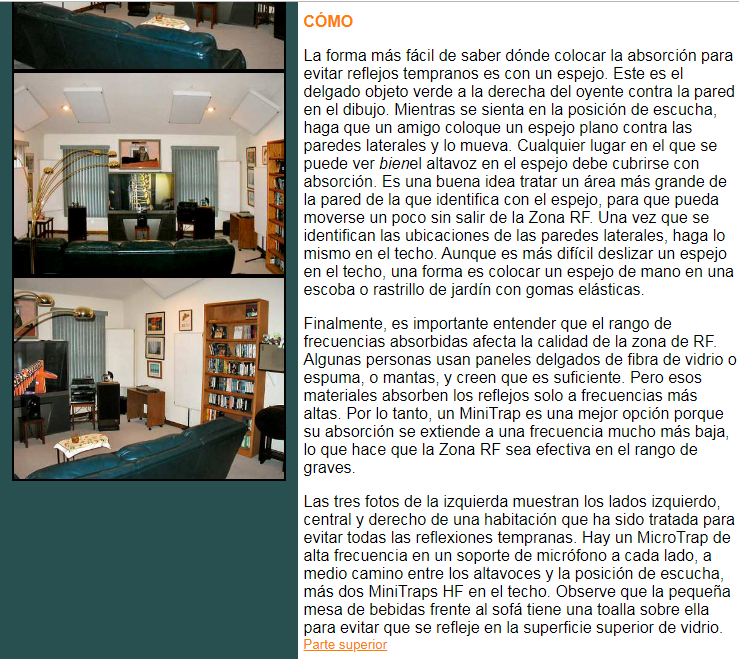
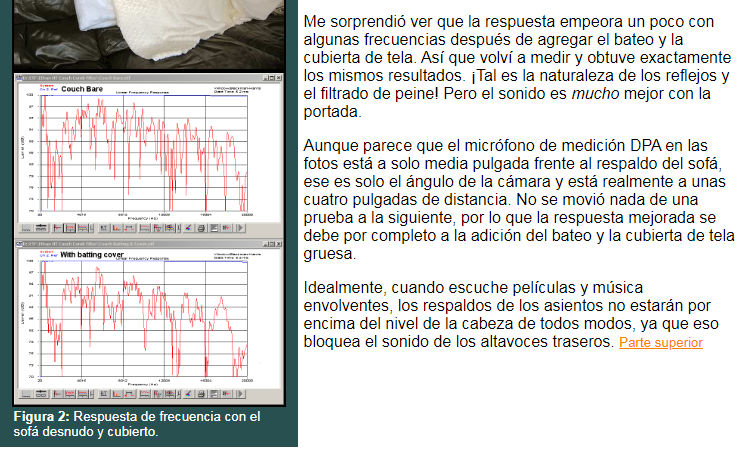
Para el que le interese porqué una sala de tamaños domésticos (cuyas cajas/oyente quedan relativamente cerca de las paredes respecto a la distancia cajas/oyente) tras tratamiento con absorbente mejora la imagen grabada (al no quedar ésta detrozada por el efecto del "comb filter/filtrado de peine").
Traducido por San Google:


https://realtraps.com/rfz.htm
Un saludete
Traducido por San Google:
https://realtraps.com/rfz.htm
Un saludete
A
atcing
Invitado
Este otro enlace es también muy bueno... y ayuda a entender con sus samplers la diferencia entre una señal pura y la misma la que se añade coloración cada "X ms", que afectan claramente al timbre original (sin delay añadido por reflexión) y a la impresión subjetiva de timbre modificado y reverberación añadida (e incluso de "eco"...si el retado supera los 100ms)
https://www.dpamicrophones.com/mic-university/the-basics-about-comb-filtering-and-how-to-avoid-it
Las grabaciones que utilizamos en nuestros sistemas ya tienen los delays propios añadidos de el entorno donde se grabaron (bien sea de un Live sin apenas retoques posteriores... y/o bien sea añadido artificialmente por el ingeniero en la mezcla vía pistas separadas).
Si a esa información grabada le añadimos de nuevo los delays de nuestra propia sala lo que hacemos (al igual que en los samplers de este enlace) es destrozar la señal grabada..
- Escuchad los samplers que cuelgo en estas capturas desde la nube o directamente desde el enlace:
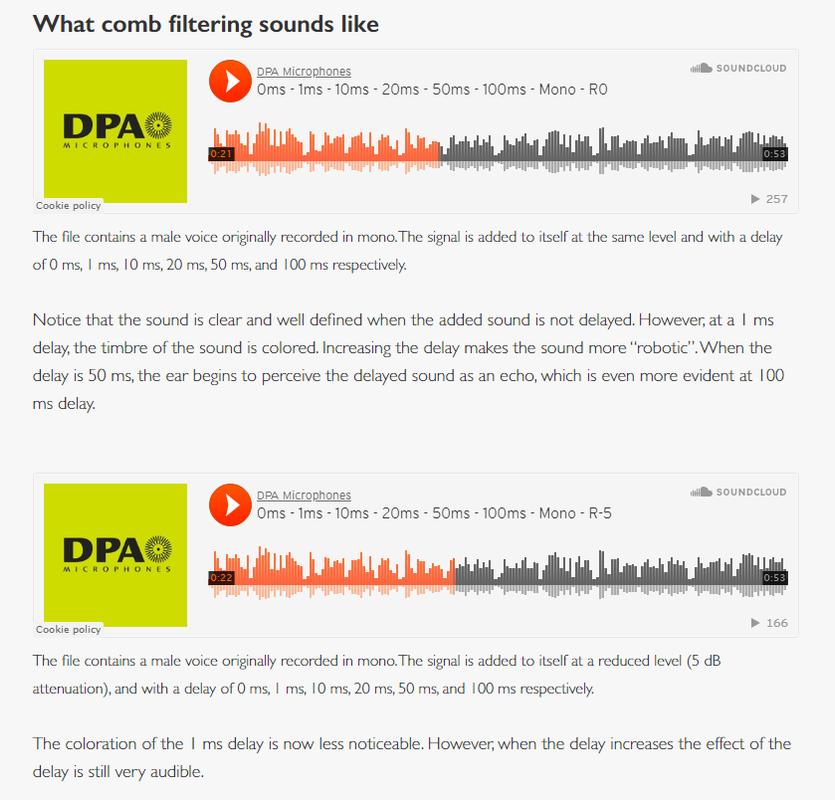
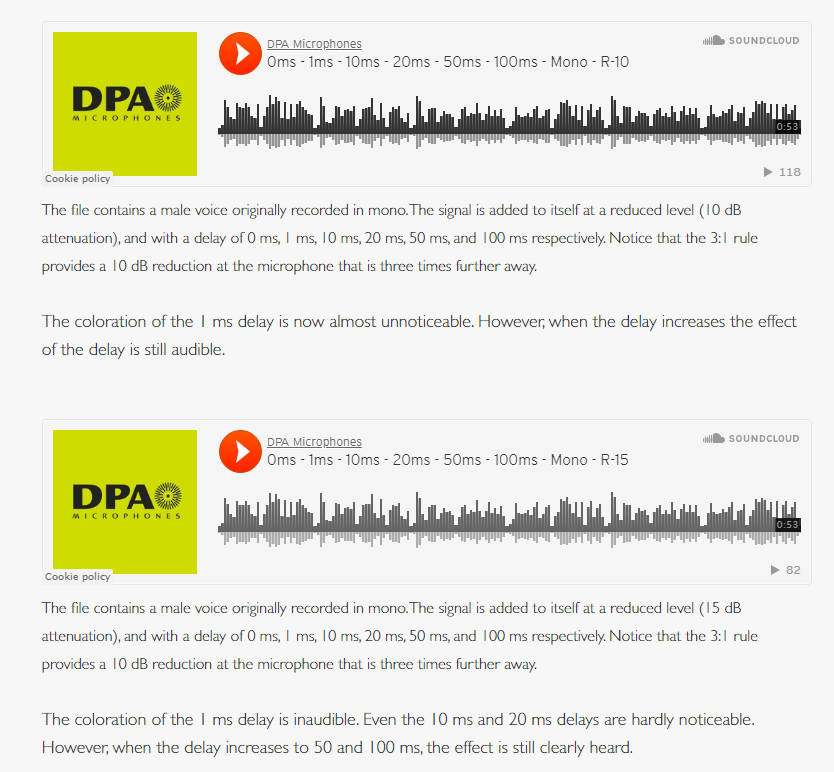
... que EMHO ayuda a comprender la coloración del entorno que audiblemente añade toda sala tanto en la grabación registrada en nuestros CD, donde ya está captado ese efecto añadido de la sala que le da un timbre y ambiencia característica a "cada CD" (que es lo que deberíamos conservar con poca coloración audible añadida)...
... y ahora pensad lo que ocurre cuando posteriormente lo DESTROZAMOS TODO añadiendo a ese entorno ya captado la coloración audbible en el timbre y ambiencia que sumaría nuestra propia sala)
- Por eso los vídeos colgados de todos los que tienen su sala la suficientemente tratada como para que ésta no añada coloración audible severa ni de timbre ni en la ambiencia grabada (diferente en cada uno de los CD a reproducir) siempre se va a parecer más al Original, pues conservan una notable mayor Alta Fidelidad (aunque los componentes del sistema sean bien baratos).
Un saludete
https://www.dpamicrophones.com/mic-university/the-basics-about-comb-filtering-and-how-to-avoid-it
Las grabaciones que utilizamos en nuestros sistemas ya tienen los delays propios añadidos de el entorno donde se grabaron (bien sea de un Live sin apenas retoques posteriores... y/o bien sea añadido artificialmente por el ingeniero en la mezcla vía pistas separadas).
Si a esa información grabada le añadimos de nuevo los delays de nuestra propia sala lo que hacemos (al igual que en los samplers de este enlace) es destrozar la señal grabada..
- Escuchad los samplers que cuelgo en estas capturas desde la nube o directamente desde el enlace:
... que EMHO ayuda a comprender la coloración del entorno que audiblemente añade toda sala tanto en la grabación registrada en nuestros CD, donde ya está captado ese efecto añadido de la sala que le da un timbre y ambiencia característica a "cada CD" (que es lo que deberíamos conservar con poca coloración audible añadida)...
... y ahora pensad lo que ocurre cuando posteriormente lo DESTROZAMOS TODO añadiendo a ese entorno ya captado la coloración audbible en el timbre y ambiencia que sumaría nuestra propia sala)
- Por eso los vídeos colgados de todos los que tienen su sala la suficientemente tratada como para que ésta no añada coloración audible severa ni de timbre ni en la ambiencia grabada (diferente en cada uno de los CD a reproducir) siempre se va a parecer más al Original, pues conservan una notable mayor Alta Fidelidad (aunque los componentes del sistema sean bien baratos).
Un saludete
A
atcing
Invitado
Y es que algunos somos muy sensibles a la coloración que modifica el timbre (de hecho ni siquiera hace falta ser profesional para detectarlo)... incluido en algunos casos la señal reflejada 27dB por debajo de la intensidad del impulso dentro de los primeros 15ms tras el impulso:
Cuelgo el resultado de un estudio bajo blind test de la audibilidad de la interferencia por comb filter:
https://pdfs.semanticscholar.org/dc81/643ed5e4c194596362286f7ca0ac9dfe6de4.pdf
- Y es que las reflexiones tempranas destrozan la señal original grabada en el CD (incluído en el timbre en según que señal haya grabada "aún con reflexiones que nos llegan al punto de escucha con más de 25dB de atenuación respecto el sonido directo")... y es indiferente de si el sistema parte de unas cajas Woxter DL410 o si lo hace de unas Sonus Faber Guarneri Homage.
Un saludete
Cuelgo el resultado de un estudio bajo blind test de la audibilidad de la interferencia por comb filter:
On the Audibility of Comb Filter Distortions
Abstract
Superpositions of delayed and undelayed versions of the same signal can occur at
different stages of the audio transmission chain. Sometimes it is a deliberate
measure to provide audio material with certain spatial or timbral qualities. Often it
is a result of multiple microphone signals, sound reflections on walls or latencies
in digital signal processing leading to comb-filter-shaped, linear distortions. The
measurement of a hearing threshold for this type of distortion with its dependance
on reflection delay, relative level and the type of audio content can be the basis for
boundaries in everyday recording practice below which undesired timbral distortions can be neglected. Therefore, a listening test was conducted to determine the
just noticeable difference for three stimulus categories (speech, a snare drum roll
and a piano phrase) and different time delays between direct and delayed signal
from 0.1 ms to 15 ms, equivalent to 0.03 - 5.15 m of sound path difference. The
results show that comb-filter distortions can still be audible if the level of the first
reflection is more than 20 dB lower than the level of the direct sound.
...
2. Listening test
The stimuli were generated using a MATLAB script. Three respresentative types of audio
signals were used: 1) a piano phrase, 2) a snare drum roll and 3) a phrase of a male speaker,
all taken from the SQUAM reference CD published by the European Broadcasting Union.
A pretest was conducted to find out the optimum duration of the stimuli to achieve the highest
sensitivity for differences between original and filtered sounds in a 3AFC situation (see
below).
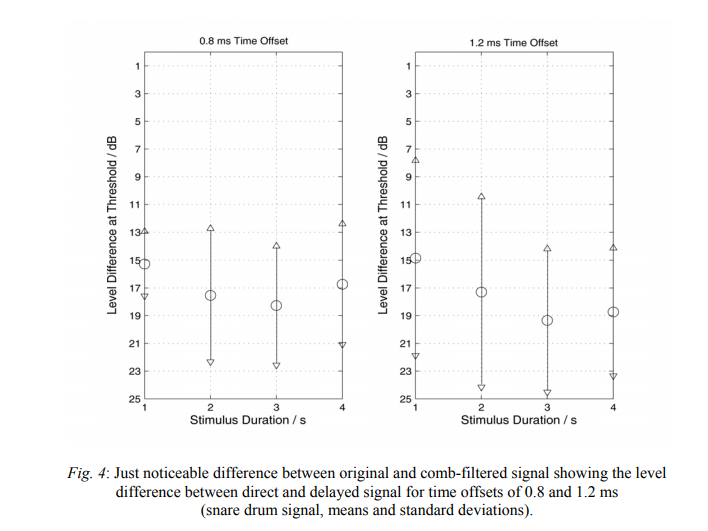
An optimal stimulus duration was found out to be 3 seconds, where a minimum in the just
noticeable difference for time offsets of 0.8 and 1.2 ms and snare drum content was detected
(Fig. 4).
The main listening test started with an instruction and a training session making the subjects
familiar with the test signals and the procedure. The monophonic stimuli were presented via
headphones (Stax SR 202). The volume could be changed during the training phase to a
comfortable level and was held constant during the rest of the test. Time offsets were tested
between 0.1 and 15 ms. An 3-Down-1-Up adaptive tracking procedure was used to approximate the threshold for the just noticeable difference in a three alternative forced choice
(3AFC) test. The subject was asked to detect the stimulus which he/she thought was manipulated using a graphical user interface. The initial values for each test procedure were set
considerably higher than the threshold values determined in a pretest to allow an extra training in each test procedure. The frequency response of the comb filter was defined by the
amplitude above 0 dB at peak frequencies. For optimal stimulus placement the step size of 0.5
dB was reduced to 0.25 dB after the first reversal that led to a “down” group. The resulting
differences in loudness were compensated for using an algorithm based on Zwicker´s loudness calculation method [10]. Following a recommendation by Leek [11] the average of the
last four turnaround points was taken as the resulting threshold value.
The subjects, 36 students and professors of the TU Berlin and the UdK Berlin with experience
in audio engineering were divided into three groups of twelve. Each group listened to one of
5
24th TONMEISTERTAGUNG – VDT INTERNATIONAL CONVENTION, November, 2006
the three stimulus types (piano, snare, speech). After the test the subjects were asked to describe the cues they used to detect the distortion. The whole test took about 45 minutes per
subject.
3. Results
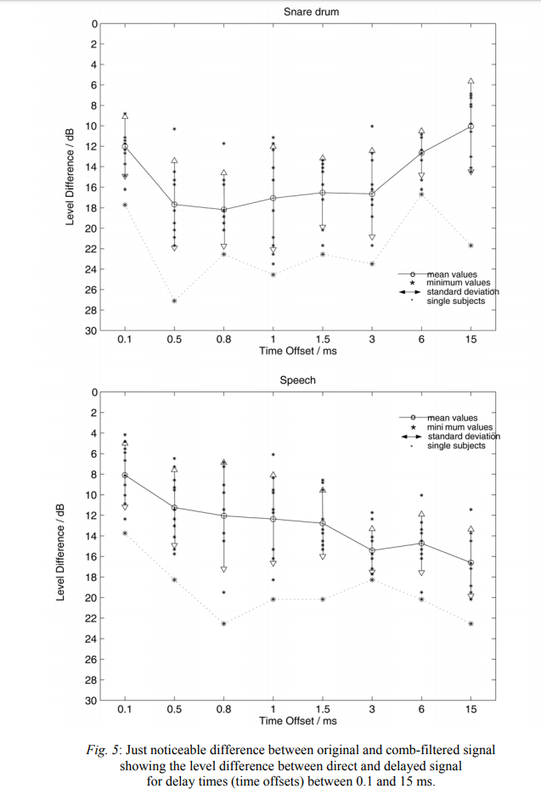
The thresholds for the three stimulus categories differ considerably. For piano and snare drum
a minimum in the mean threshold of all subjects was found at 0.8 ms time offset. The mean
level difference between direct sound and first reflection is 13.2 dB at the threshold for piano
and 18.2 dB for snare drum, with single subjects reliably detected level differences as much as
21.5 dB (piano) and 27 dB (snare drum). The threshold curve for the speech signal shows a
trend to an easier detection of the distortion with growing time offset. For a time offset of 15
ms the just audible difference was detected at a level difference of 16 dB (average) resp. 22
dB (single subject), requiring an extension for futere tests towards higher time offsets.

6
24th TONMEISTERTAGUNG – VDT INTERNATIONAL CONVENTION, November, 2006
Fig. 5: Just noticeable difference between original and comb-filtered signal
showing the level difference between direct and delayed signal
for delay times (time offsets) between 0.1 and 15 ms.
7
24th TONMEISTERTAGUNG – VDT INTERNATIONAL CONVENTION, November, 2006
4. Discussion
The present study proved that listeners are considerably more sensitive to frequency response
irregularities than suggested by previous investigations. For certain audio material and under
good listening conditions differences are audible when a reflection with a level difference of
18 dB (average of all listeners) respectively 27 dB (single listeners) is added. This corresponds to peaks in the comb-filter curve (Fig. 2) of 1 dB (average) and less than 0.4 dB
(single listeners). Kuhl’s finding was confirmed that listeners are particularly sensitive for
changes in timbre when dealing with noisy signals [5]. Maximum sensitivity for added reflections and broadband content is reached at time offsets between 0.1 and 1 ms, depending on
content and listener, while sensitivity with speech content rises with ascending time offset and
a minimum was not found below 15 ms.
Applied to the above mentioned occasions where comb-filter-shaped distortions can occur in
the audio transmission chain we deduce that an electrical/digital superposition of identical but
delayed content can be audible even if the delayed signal is as much as 27 dB lower than the
direct signal. In situations where the delayed signal undergoes filtering when travelling
through air oder being reflected on walls the peaks and dips in the frequency response will be
less pronounced and the established threshold can be regarded as a lower boundary. With
acoustical superpositions of sound waves a comb filter distortion will only occur for the freefield part of the sound since the diffuse-field portion looses time-coherence, thus no combfilter distortion will occur.
Even in those situations we can assume that for content with broadband frequency distribution
such as the pink-noise-like snare drum signal a distortion will be best audible for time offsets
between 0.5 and 3 ms (Fig. 5) corresponding to sound path distances between 17 cm and 1 m.
These sound path distances between microphones or at reflecting surfaces should be particularly avoided.
Further research has to be done on the perceived sound quality of added reflections. Subjects
named timbral differences to be the primary cue for the piano signal, some named the perception of a residual pitch as the primary cue for the snare drum signal, whereas for the
speech signal the primary detection cue was an impression of spaciousness even for small
time offsets.
An interesting side observation is the suggested optimal signal duration of 3 s for the recognition of frequence response irregularities in direct AB comparisons – a situation that regularly
occurs in sound engineering practice. The broad range of threshold values even for trained
listeners was unexpected, as well as the fact that the distribution for experienced sound
engineers was not much different from non-professionals among the 36 tested subjects.
Hence, audio professionals should always be aware that some of their clients might be more
sensitive to distortions than they are themselves.
https://pdfs.semanticscholar.org/dc81/643ed5e4c194596362286f7ca0ac9dfe6de4.pdf
- Y es que las reflexiones tempranas destrozan la señal original grabada en el CD (incluído en el timbre en según que señal haya grabada "aún con reflexiones que nos llegan al punto de escucha con más de 25dB de atenuación respecto el sonido directo")... y es indiferente de si el sistema parte de unas cajas Woxter DL410 o si lo hace de unas Sonus Faber Guarneri Homage.
Un saludete
A
atcing
Invitado
Este mensaje lo que quería escribir justo seguido del anterior (por eso el "reservado"... que ya sabía alguno que otro metería su troleo típico de por medio), ya que tiene relación:
Traducido por San Google (aunque se entiende menos que en inglés):
https://ethanwiner.com/acoustics.html
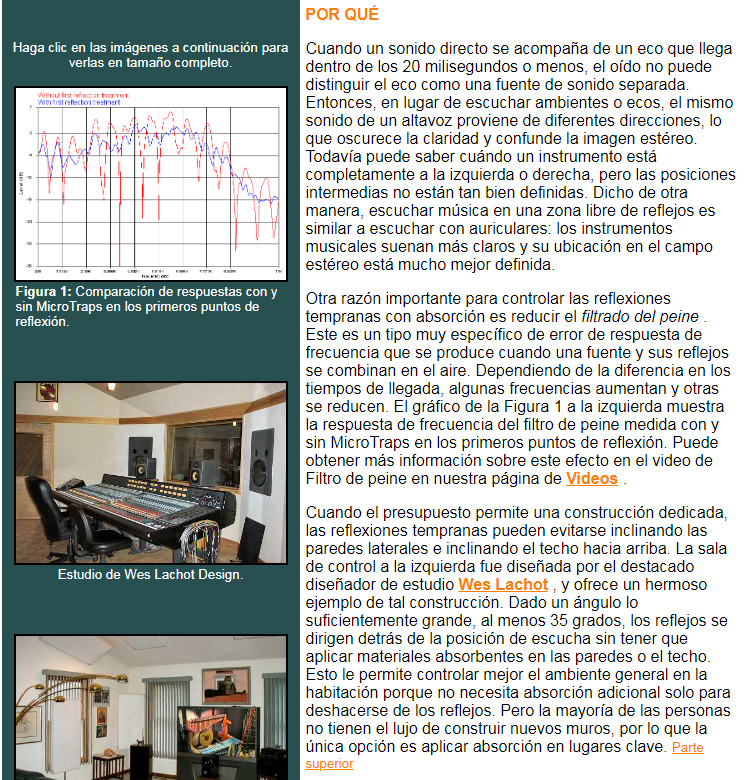
Tras colocar los paneles Microtraps en primeras reflexiones (línea azul) la señal original se mantiene con notables menores altibajos al reducir el efecto peine que destroza la imagen grabada (tan y como se muestra en la gráfica)
Un saludete
Traducido por San Google (aunque se entiende menos que en inglés):
CREANDO UNA ZONA LIBRE DE REFLEXIÓN
El QUÉ:
Un objetivo útil para cualquier habitación donde se escuche música a través de altavoces es crear una zona libre de reflexión (RFZ) en la posición de escucha. El concepto es muy simple: evitar que los "reflejos tempranos" oscurezcan la imagen estéreo. Esto ocurre cuando el sonido de los altavoces llega a sus oídos a través de dos caminos diferentes, uno directo y otro retrasado después de reflejarse en una pared cercana.
Igual de perjudicial es cuando el sonido del altavoz izquierdo rebota en la pared derecha y llega al oído derecho, y viceversa. Del mismo modo, los reflejos tempranos del techo y el piso también pueden dañar la claridad y las imágenes. En todos los casos, los reflejos oscurecen los detalles finos y dificultan la localización de la fuente del sonido o instrumento musical.
Este dibujo, visto desde arriba, muestra los tres caminos principales por los cuales el sonido de un altavoz llega a sus oídos. El sonido directo se muestra como líneas negras. Los primeros reflejos, un solo rebote en una superficie cercana, son las líneas rojas, y los ecos tardíos y el ambiente llegan como se muestra en azul. En verdad, las líneas azules son mucho más complejas y densas que la ruta única que se muestra aquí, pero esto es suficiente para explicar el concepto.
El objetivo general de una zona libre de reflexión es eliminar los caminos rojos de reflexión temprana colocando paneles absorbentes en las paredes laterales en ubicaciones clave. No se muestran, pero es igualmente importante evitarlos, son reflejos tempranos del techo, el piso y la mesa de mezclas si están presentes. Parte superior
Reflexiones tempranas
El POR QUÉ: Cuando un sonido directo se acompaña de un eco que llega dentro de los 20 milisegundos o menos, el oído no puede distinguir el eco como una fuente de sonido separada. Entonces, en lugar de sonar como un eco o un ambiente de sala general, los sonidos que provienen de diferentes direcciones se combinan, lo que oscurece la claridad y confunde la imagen estéreo. Aún puede saber cuándo un instrumento se desplaza hacia la izquierda o hacia la derecha, pero las posiciones intermedias no están tan bien definidas. Dicho de otra manera, escuchar música en una zona libre de reflejos es similar a escuchar con auriculares: los instrumentos musicales suenan más claros y su ubicación en el campo estéreo está mucho mejor definida.
Haga clic para ver una versión más grande
Haga clic en la imagen de arriba para ver una versión más grande.
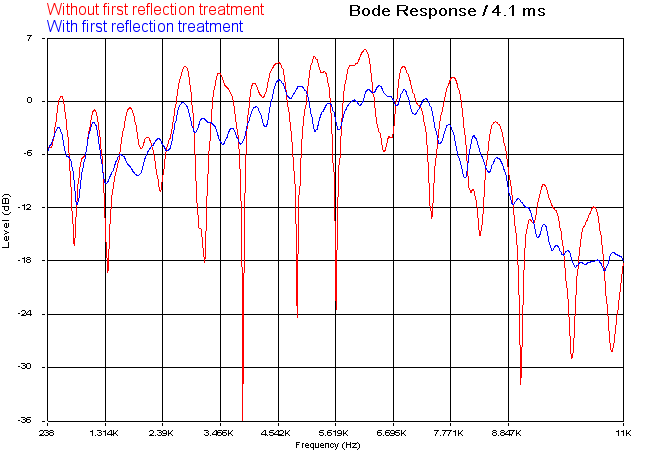
Otra razón importante para controlar las reflexiones tempranas con absorción es reducir el filtrado del peine . Este es un tipo muy específico de error de respuesta de frecuencia que se produce cuando una fuente y sus reflejos se combinan en el aire. Dependiendo de la diferencia en los tiempos de llegada, algunas frecuencias aumentan y otras se reducen. El gráfico de la izquierda muestra la respuesta de frecuencia del filtro de peine medida con y sin MicroTraps en los primeros puntos de reflexión:
https://ethanwiner.com/acoustics.html
Tras colocar los paneles Microtraps en primeras reflexiones (línea azul) la señal original se mantiene con notables menores altibajos al reducir el efecto peine que destroza la imagen grabada (tan y como se muestra en la gráfica)
Un saludete
L
luco_mtb
Invitado
N
new_golf
Invitado
reservado
Un saludete
Si no vaya a ser que te lo quiten ��

hemiutut
Miembro7.157 mensajesdesde 2011
8.790 agradecimientos
Para el que le interese porqué una sala de tamaños domésticos (cuyas cajas/oyente quedan relativamente cerca de las paredes respecto a la distancia cajas/oyente) tras tratamiento con absorbente mejora la imagen grabada (al no quedar ésta detrozada por el efecto del "comb filter/filtrado de peine").
Traducido por San Google:
https://realtraps.com/rfz.htm
Un saludete
Muy buen post y la gente que tenga claro que un sofá tapizado en polipiel,piel,no es lo más adecuado
desde el punto de la acústica.
Si os da igual,elegir un tapizado poroso ( que deje pasar el aire ).
Saludos.
hemiutut
Miembro7.157 mensajesdesde 2011
8.790 agradecimientos
Y es que algunos somos muy sensibles a la coloración que modifica el timbre (de hecho ni siquiera hace falta ser profesional para detectarlo)... incluido en algunos casos la señal reflejada 27dB por debajo de la intensidad del impulso dentro de los primeros 15ms tras el impulso:
Cuelgo el resultado de un estudio bajo blind test de la audibilidad de la interferencia por comb filter:
https://pdfs.semanticscholar.org/dc81/643ed5e4c194596362286f7ca0ac9dfe6de4.pdf
- Y es que las reflexiones tempranas destrozan la señal original grabada en el CD (incluído en el timbre en según que señal haya grabada "aún con reflexiones que nos llegan al punto de escucha con más de 25dB de atenuación respecto el sonido directo")... y es indiferente de si el sistema parte de unas cajas Woxter DL410 o si lo hace de unas Sonus Faber Guarneri Homage.
Un saludete
Otro post muy bueno donde se aporta mucha información.
Saludos.
hemiutut
Miembro7.157 mensajesdesde 2011
8.790 agradecimientos
Hoy he probado la configuración Dual Channel,caray con sus 30 watios para un canal.
T20 y T30 de mi comedor con tan sólo 2 cilindros de copopren y el panel de espuma de 100x80x20 cms de espesor
detrás del plasma.
Aparte del mobiliario propio,cortinas,alfombra,etc.
Otro día mediré con los 50 cojines ;D ;D

Saludos.
T20 y T30 de mi comedor con tan sólo 2 cilindros de copopren y el panel de espuma de 100x80x20 cms de espesor
detrás del plasma.
Aparte del mobiliario propio,cortinas,alfombra,etc.
Otro día mediré con los 50 cojines ;D
;D
Saludos.
K
kaos26
Invitado
Hoy he probado la configuración Dual Channel,caray con sus 30 watios para un canal.
T20 y T30 de mi comedor con tan sólo 2 cilindros de copopren y el panel de espuma de 100x80x20 cms de espesor
detrás del plasma.
Aparte del mobiliario propio,cortinas,alfombra,etc.
Otro día mediré con los 50 cojines ;D
Saludos.
Hemi lo tuyo es grave , te repites hasta aburrir , no te conformas con poner este post aquí ,sin ningún interés que lo repites aquí y en el hilo de las woxter , la lección de copia/pega del maestro , lo bordas ;D.

A
atcing
Invitado
atcing dijo:Para el que le interese porqué una sala de tamaños domésticos (cuyas cajas/oyente quedan relativamente cerca de las paredes respecto a la distancia cajas/oyente) tras tratamiento con absorbente mejora la imagen grabada (al no quedar ésta detrozada por el efecto del "comb filter/filtrado de peine").
Traducido por San Google:
https://realtraps.com/rfz.htm
Un saludete
Muy buen post y la gente que tenga claro que un sofá tapizado en polipiel,piel,no es lo más adecuado
desde el punto de la acústica.
Si os da igual,elegir un tapizado poroso ( que deje pasar el aire ).
Saludos.
Si es que está tan claro.
Un saludete
A
atcing
Invitado
atcing dijo:Y es que algunos somos muy sensibles a la coloración que modifica el timbre (de hecho ni siquiera hace falta ser profesional para detectarlo)... incluido en algunos casos la señal reflejada 27dB por debajo de la intensidad del impulso dentro de los primeros 15ms tras el impulso:
Cuelgo el resultado de un estudio bajo blind test de la audibilidad de la interferencia por comb filter:
On the Audibility of Comb Filter Distortions
Abstract
Superpositions of delayed and undelayed versions of the same signal can occur at
different stages of the audio transmission chain. Sometimes it is a deliberate
measure to provide audio material with certain spatial or timbral qualities. Often it
is a result of multiple microphone signals, sound reflections on walls or latencies
in digital signal processing leading to comb-filter-shaped, linear distortions. The
measurement of a hearing threshold for this type of distortion with its dependance
on reflection delay, relative level and the type of audio content can be the basis for
boundaries in everyday recording practice below which undesired timbral distortions can be neglected. Therefore, a listening test was conducted to determine the
just noticeable difference for three stimulus categories (speech, a snare drum roll
and a piano phrase) and different time delays between direct and delayed signal
from 0.1 ms to 15 ms, equivalent to 0.03 - 5.15 m of sound path difference. The
results show that comb-filter distortions can still be audible if the level of the first
reflection is more than 20 dB lower than the level of the direct sound.
...
2. Listening test
The stimuli were generated using a MATLAB script. Three respresentative types of audio
signals were used: 1) a piano phrase, 2) a snare drum roll and 3) a phrase of a male speaker,
all taken from the SQUAM reference CD published by the European Broadcasting Union.
A pretest was conducted to find out the optimum duration of the stimuli to achieve the highest
sensitivity for differences between original and filtered sounds in a 3AFC situation (see
below).
An optimal stimulus duration was found out to be 3 seconds, where a minimum in the just
noticeable difference for time offsets of 0.8 and 1.2 ms and snare drum content was detected
(Fig. 4).
The main listening test started with an instruction and a training session making the subjects
familiar with the test signals and the procedure. The monophonic stimuli were presented via
headphones (Stax SR 202). The volume could be changed during the training phase to a
comfortable level and was held constant during the rest of the test. Time offsets were tested
between 0.1 and 15 ms. An 3-Down-1-Up adaptive tracking procedure was used to approximate the threshold for the just noticeable difference in a three alternative forced choice
(3AFC) test. The subject was asked to detect the stimulus which he/she thought was manipulated using a graphical user interface. The initial values for each test procedure were set
considerably higher than the threshold values determined in a pretest to allow an extra training in each test procedure. The frequency response of the comb filter was defined by the
amplitude above 0 dB at peak frequencies. For optimal stimulus placement the step size of 0.5
dB was reduced to 0.25 dB after the first reversal that led to a “down” group. The resulting
differences in loudness were compensated for using an algorithm based on Zwicker´s loudness calculation method [10]. Following a recommendation by Leek [11] the average of the
last four turnaround points was taken as the resulting threshold value.
The subjects, 36 students and professors of the TU Berlin and the UdK Berlin with experience
in audio engineering were divided into three groups of twelve. Each group listened to one of
5
24th TONMEISTERTAGUNG – VDT INTERNATIONAL CONVENTION, November, 2006
the three stimulus types (piano, snare, speech). After the test the subjects were asked to describe the cues they used to detect the distortion. The whole test took about 45 minutes per
subject.
3. Results
The thresholds for the three stimulus categories differ considerably. For piano and snare drum
a minimum in the mean threshold of all subjects was found at 0.8 ms time offset. The mean
level difference between direct sound and first reflection is 13.2 dB at the threshold for piano
and 18.2 dB for snare drum, with single subjects reliably detected level differences as much as
21.5 dB (piano) and 27 dB (snare drum). The threshold curve for the speech signal shows a
trend to an easier detection of the distortion with growing time offset. For a time offset of 15
ms the just audible difference was detected at a level difference of 16 dB (average) resp. 22
dB (single subject), requiring an extension for futere tests towards higher time offsets.
6
24th TONMEISTERTAGUNG – VDT INTERNATIONAL CONVENTION, November, 2006
Fig. 5: Just noticeable difference between original and comb-filtered signal
showing the level difference between direct and delayed signal
for delay times (time offsets) between 0.1 and 15 ms.
7
24th TONMEISTERTAGUNG – VDT INTERNATIONAL CONVENTION, November, 2006
4. Discussion
The present study proved that listeners are considerably more sensitive to frequency response
irregularities than suggested by previous investigations. For certain audio material and under
good listening conditions differences are audible when a reflection with a level difference of
18 dB (average of all listeners) respectively 27 dB (single listeners) is added. This corresponds to peaks in the comb-filter curve (Fig. 2) of 1 dB (average) and less than 0.4 dB
(single listeners). Kuhl’s finding was confirmed that listeners are particularly sensitive for
changes in timbre when dealing with noisy signals [5]. Maximum sensitivity for added reflections and broadband content is reached at time offsets between 0.1 and 1 ms, depending on
content and listener, while sensitivity with speech content rises with ascending time offset and
a minimum was not found below 15 ms.
Applied to the above mentioned occasions where comb-filter-shaped distortions can occur in
the audio transmission chain we deduce that an electrical/digital superposition of identical but
delayed content can be audible even if the delayed signal is as much as 27 dB lower than the
direct signal. In situations where the delayed signal undergoes filtering when travelling
through air oder being reflected on walls the peaks and dips in the frequency response will be
less pronounced and the established threshold can be regarded as a lower boundary. With
acoustical superpositions of sound waves a comb filter distortion will only occur for the freefield part of the sound since the diffuse-field portion looses time-coherence, thus no combfilter distortion will occur.
Even in those situations we can assume that for content with broadband frequency distribution
such as the pink-noise-like snare drum signal a distortion will be best audible for time offsets
between 0.5 and 3 ms (Fig. 5) corresponding to sound path distances between 17 cm and 1 m.
These sound path distances between microphones or at reflecting surfaces should be particularly avoided.
Further research has to be done on the perceived sound quality of added reflections. Subjects
named timbral differences to be the primary cue for the piano signal, some named the perception of a residual pitch as the primary cue for the snare drum signal, whereas for the
speech signal the primary detection cue was an impression of spaciousness even for small
time offsets.
An interesting side observation is the suggested optimal signal duration of 3 s for the recognition of frequence response irregularities in direct AB comparisons – a situation that regularly
occurs in sound engineering practice. The broad range of threshold values even for trained
listeners was unexpected, as well as the fact that the distribution for experienced sound
engineers was not much different from non-professionals among the 36 tested subjects.
Hence, audio professionals should always be aware that some of their clients might be more
sensitive to distortions than they are themselves.
https://pdfs.semanticscholar.org/dc81/643ed5e4c194596362286f7ca0ac9dfe6de4.pdf
- Y es que las reflexiones tempranas destrozan la señal original grabada en el CD (incluído en el timbre en según que señal haya grabada "aún con reflexiones que nos llegan al punto de escucha con más de 25dB de atenuación respecto el sonido directo")... y es indiferente de si el sistema parte de unas cajas Woxter DL410 o si lo hace de unas Sonus Faber Guarneri Homage.
Un saludete
Otro post muy bueno donde se aporta mucha información.
Saludos.
Los blind test ponen todo en su lugar... y como no, lo detectable que es la coloración de la sala también (incluso algunos detectando reflexiones con 27dB menos de energía que el impulso dentro de los primeros 15ms). Para lograr esto en una sala/salón de tamaño doméstico (incluido de tamaño considerable) ya podemos colocar absorción en primeras reflexiones....
Un saludete
L
luco_mtb
Invitado
Los damper lo mejor.
Pitufo pobre.
A
atcing
Invitado
Hemi lo tuyo es grave , te repites hasta aburrir , no te conformas con poner este post aquí ,sin ningún interés que lo repites aquí y en el hilo de las woxter , la lección de copia/pega del maestro , lo bordas ;D.
Bufff, ya estamos otra vez con el troleo de índole personal ! >(
No se qué tiene de raro que lo ponga en el hilo de las woxter y en este hilo que abrí donde también se está debatiendo el tema.
- Eso de sin interés será tu opinión personal...
Hoy he probado la configuración Dual Channel,caray con sus 30 watios para un canal.
T20 y T30 de mi comedor con tan sólo 2 cilindros de copopren y el panel de espuma de 100x80x20 cms de espesor
detrás del plasma.
Aparte del mobiliario propio,cortinas,alfombra,etc.
Otro día mediré con los 50 cojines ;D
Saludos.
Ya te vale ;D... y lo bien que te lo pasas con el cacharreo!
Un saludete
hemiutut
Miembro7.157 mensajesdesde 2011
8.790 agradecimientos
Hemi lo tuyo es grave , te repites hasta aburrir , no te conformas con poner este post aquí ,sin ningún interés que lo repites aquí y en el hilo de las woxter , la lección de copia/pega del maestro , lo bordas ;D.
kaos,ya que criticas tanto como muchos otros,probar los Woxter en Dual Channel:
Configuración Dual Channel Woxter DL410 para cada Frontal + Arendal Sub1
Punto de escucha a 2.70 metros.
T20 y T30 de mi comedor con tan sólo 2 cilindros de copopren y el panel de espuma de 100x80x20 cms de espesor
detrás del plasma.
Aparte del mobiliario propio,cortinas,alfombra,etc.
Estos son los cables que uso en cada salida pre-out Frontal del Avr
https://www.amazon.es/AmazonBasics-...ocphy=1005539&hvtargid=pla-306172895444&psc=1
Saludos.

Huguito
Miembro2.913 mensajesdesde 2008
3.667 agradecimientos
Venía a ver si se había terminado ya el hi-end, que es un tema que no me deja dormir y lo que veo es que Hemi se ha inventado un nuevo término, o mejor, lo ha oído en algún sitio y ha pensado que sonaba a que sabía mucho
Por si algún nuevo está leyendo este hilo y cree que hay un mesías que convierte el Woxter en vino, que por favor busque en Google Dual Channel Audio o Dual Channel mono
Y que vea por sí mismo lo que significa...
Por si algún nuevo está leyendo este hilo y cree que hay un mesías que convierte el Woxter en vino, que por favor busque en Google Dual Channel Audio o Dual Channel mono
Y que vea por sí mismo lo que significa...
A
atcing
Invitado
kaos,ya que criticas tanto como muchos otros,probar los Woxter en Dual Channel:
Configuración Dual Channel Woxter DL410 para cada Frontal + Arendal Sub1
Punto de escucha a 2.70 metros.
T20 y T30 de mi comedor con tan sólo 2 cilindros de copopren y el panel de espuma de 100x80x20 cms de espesor
detrás del plasma.
Aparte del mobiliario propio,cortinas,alfombra,etc.
Estos son los cables que uso en cada salida pre-out Frontal del Avr
https://www.amazon.es/AmazonBasics-...ocphy=1005539&hvtargid=pla-306172895444&psc=1
Saludos.
Realizar pruebas es divertido. Se entiende perfectamente a lo que te refieres con lo de "Dual Chanel Audio" viendo la captura.
- No creo que unas Woxter se puedan convertir en vino (los esoterismos para otros)... como tampoco creo en el esoterismo de que unas Wilson Audio en sala grande sin tratar a 3m sonará tan a Alta Fidelidad como unas Woxter DL410 cortadas con un sub a 1.1 m en una sala con tratamiento agresivo:
- Para lograr mayor Alta Fidelidad que en una sala sin tratar a 3/4m (o más) de las cajas, ni siquiera me hacen falta las Infinity Beta20 como cajas principales: para mi configuración en campo cercano a 1.1m (con todas las virtudes objetivas que tiene el campo cercano en el ITDG + en distanciar las reflexiones respecto al sonido directo) me basta con las Woxter DL410 cortadas con un sub (y eso que la sala actual tiene mejor acústica tras el cambio de paneles que en el siguiente vídeo que grabé hace tiempo + las DL410 jamás las puse a a altura óptima donde sí están las beta20, para aprovechar al máximo la efectividad de los paneles):
39b Test Woxter DL410 + Adam sub12 EQ UC:
Tema Original:
- Sistema mucho más parecido al Original.... que el siguiente otro sistema (cuyos componentes: Wilson Audio WATT/Puppy 8 DAC: Accuphase DC-37 - PreAmp: Accuphase C-3800 - Amp: VAC 300.1, cuestan más de 60 veces más!!!) aún grabado con un sistema de micros muchísimo mejor (7-8 veces más caro)... pero en sala sin tratara pesar de estar grabado sólo a 2m de distancia (a 3/4m todavía habría más coloración añadida) :
Porque no es casualidad que mis vídeos (aún con unas Woxter DL410 como cajas principales) se acerquen notablemente más al Original... es la tozuda realidad de la física
Un saludete
D
deone
Invitado
Venía a ver si se había terminado ya el hi-end, que es un tema que no me deja dormir y lo que veo es que Hemi se ha inventado un nuevo término, o mejor, lo ha oído en algún sitio y ha pensado que sonaba a que sabía mucho
Por si algún nuevo está leyendo este hilo y cree que hay un mesías que convierte el Woxter en vino, que por favor busque en Google Dual Channel Audio o Dual Channel mono
Y que vea por sí mismo lo que significa...
Supongo que se referirá a "doble frontal", lo poco que he leído d dual chanel nada tiene que ver con eso

D
deone
Invitado
Esto lo leí el otro día en el artículo que puse y la verdad me pareció curioso:
Un loco del sonido convertido en escritor
Gideon Schwart nació en Nueva York, ciudad en la que sigue viviendo, y durante muchos años se dedicó a la abogacía hasta que la abandonó en 2009 para dedicarse a su gran afición: los equipos de sonido Hi-Fi. Schwart fundó el salón de gama ultraalta Audioarts, un lugar en el que se ofrecen los mejores productos y en el que se diseñan equipos de interior a medida para una importante clientela. `Un loco del sonido´ y experto en el tema que anda en busca de lo que él mismo denomina como “la verdad musical” y que no es otra cosa que acercarse lo más posible a sentir plenamente a los músicos grabados como se podría hacer en la vida real. Esto se consigue a través de equipos que pueden proporcionar al usuario experiencias emocionales y etéreas extraordinarias pero, y he aquí un detalle muy importante, con el importante aporte del diseño y de una fabricación industrial de gran calidad. La suma de arte musical con una reproducción perfecta y con un diseño exquisito preserva el espíritu e intención de todo artista.
K
kaos26
Invitado
kaos,ya que criticas tanto como muchos otros,probar los Woxter en Dual Channel:
Configuración Dual Channel Woxter DL410 para cada Frontal + Arendal Sub1
Punto de escucha a 2.70 metros.
T20 y T30 de mi comedor con tan sólo 2 cilindros de copopren y el panel de espuma de 100x80x20 cms de espesor
detrás del plasma.
Aparte del mobiliario propio,cortinas,alfombra,etc.
Estos son los cables que uso en cada salida pre-out Frontal del Avr
https://www.amazon.es/AmazonBasics-...ocphy=1005539&hvtargid=pla-306172895444&psc=1
Saludos.
Unas cajas baratas de pc ofrecen un sonido mediocre , dos cajas de pc ofrecen lo mismo multiplicado por dos , como entretenimiento lo veo bien , recomendarlo me parece absurdo , he escuchado 4 parejas y se lo que son capaces , a partir de ahi , todo lo que se refiera a estas cajas es perder el tiempo.
A
atcing
Invitado
Unas cajas baratas de pc ofrecen un sonido mediocre , dos cajas de pc ofrecen lo mismo multiplicado por dos , como entretenimiento lo veo bien , recomendarlo me parece absurdo , he escuchado 4 parejas y se lo que son capaces , a partir de ahi , todo lo que se refiera a estas cajas es perder el tiempo.
Eso es falso: Unas cajas de PC (al menos como la de las woxter DL410 de 35 euros pareja cuya THD es similar a las Genelec 8020 de 650/750 euros pareja) cortadas con un sub + si se sabe optimizar la sala y la EQ ofrecen en campo cercano una neutralidad de sondo imposible de lograr con cualquier otro sistema (aunque sea el mas caro del planeta) en sala normal sin tratada a 3/4m de las cajas (o más)... como bien se escucha en estos vídeos comparativos:
atcing dijo:- Para lograr mayor Alta Fidelidad que en una sala sin tratar a 3/4m (o más) de las cajas, ni siquiera me hacen falta las Infinity Beta20 como cajas principales: para mi configuración en campo cercano a 1.1m (con todas las virtudes objetivas que tiene el campo cercano en el ITDG + en distanciar las reflexiones respecto al sonido directo) me basta con las Woxter DL410 cortadas con un sub (y eso que la sala actual tiene mejor acústica tras el cambio de paneles que en el siguiente vídeo que grabé hace tiempo + las DL410 jamás las puse a a altura óptima donde sí están las beta20, para aprovechar al máximo la efectividad de los paneles):
39b Test Woxter DL410 + Adam sub12 EQ UC:
Tema Original:
- Sistema mucho más parecido al Original.... que el siguiente otro sistema (cuyos componentes: Wilson Audio WATT/Puppy 8 DAC: Accuphase DC-37 - PreAmp: Accuphase C-3800 - Amp: VAC 300.1, cuestan más de 60 veces más!!!) aún grabado con un sistema de micros muchísimo mejor (7-8 veces más caro)... pero en sala sin tratara pesar de estar grabado sólo a 2m de distancia (a 3/4m todavía habría más coloración añadida) :
Porque no es casualidad que mis vídeos (aún con unas Woxter DL410 como cajas principales) se acerquen notablemente más al Original... es la tozuda realidad de la física
Y además , la diferencia es enoooooooorme a favor de las Woxter DL410 cortadas con el sub en la sala tratada: es lo que tiene invertir en lo que de verdad marca las grandes diferencias en la calidad de sonido vs dejar lo que destroza la señal:
- En el siguiente enlace que colgué se detalle y escucha (en sus samplers de audio) con claridad, cómo las reflexiones añadidas a varios ms tras el impulso (lo que ocurre en una sala sin tratar) destrozan la señal original:
atcing dijo:Este otro enlace es también muy bueno... y ayuda a entender con sus samplers la diferencia entre una señal pura y la misma la que se añade coloración cada "X ms", que afectan claramente al timbre original (sin delay añadido por reflexión) y a la impresión subjetiva de timbre modificado y reverberación añadida (e incluso de "eco"...si el retado supera los 100ms)
https://www.dpamicrophones.com/mic-university/the-basics-about-comb-filtering-and-how-to-avoid-it
Las grabaciones que utilizamos en nuestros sistemas ya tienen los delays propios añadidos de el entorno donde se grabaron (bien sea de un Live sin apenas retoques posteriores... y/o bien sea añadido artificialmente por el ingeniero en la mezcla vía pistas separadas).
Si a esa información grabada le añadimos de nuevo los delays de nuestra propia sala lo que hacemos (al igual que en los samplers de este enlace) es destrozar la señal grabada..
- Escuchad los samplers que cuelgo en estas capturas desde la nube o directamente desde el enlace:
... que EMHO ayuda a comprender la coloración del entorno que audiblemente añade toda sala tanto en la grabación registrada en nuestros CD, donde ya está captado ese efecto añadido de la sala que le da un timbre y ambiencia característica a "cada CD" (que es lo que deberíamos conservar con poca coloración audible añadida)...
... y ahora pensad lo que ocurre cuando posteriormente lo DESTROZAMOS TODO añadiendo a ese entorno ya captado la coloración audbible en el timbre y ambiencia que sumaría nuestra propia sala)
- Por eso los vídeos colgados de todos los que tienen su sala la suficientemente tratada como para que ésta no añada coloración audible severa ni de timbre ni en la ambiencia grabada (diferente en cada uno de los CD a reproducir) siempre se va a parecer más al Original, pues conservan una notable mayor Alta Fidelidad (aunque los componentes del sistema sean bien baratos).
Un saludete
Un saludete
A
atcing
Invitado
Esto lo leí el otro día en el artículo que puse y la verdad me pareció curioso:
Un loco del sonido convertido en escritor
Gideon Schwart nació en Nueva York, ciudad en la que sigue viviendo, y durante muchos años se dedicó a la abogacía hasta que la abandonó en 2009 para dedicarse a su gran afición: los equipos de sonido Hi-Fi. Schwart fundó el salón de gama ultraalta Audioarts, un lugar en el que se ofrecen los mejores productos y en el que se diseñan equipos de interior a medida para una importante clientela. `Un loco del sonido´ y experto en el tema que anda en busca de lo que él mismo denomina como “la verdad musical” y que no es otra cosa que acercarse lo más posible a sentir plenamente a los músicos grabados como se podría hacer en la vida real. Esto se consigue a través de equipos que pueden proporcionar al usuario experiencias emocionales y etéreas extraordinarias pero, y he aquí un detalle muy importante, con el importante aporte del diseño y de una fabricación industrial de gran calidad. La suma de arte musical con una reproducción perfecta y con un diseño exquisito preserva el espíritu e intención de todo artista.
Bajo mediciones lo que dice ese artículo sensacionalista (donde no leo nada de científico) quiere ese señor lograr (o acercarse lo máximo posible a ello) con sistemas de reproducción de señal grabada, es tan sencillo como utilizar buenas grabaciones en salas suficientemente neutras para punto de escucha como para no destrozar esa excelente toma de sonido: algo que ya se logra desde componentes de audio muy baratos en salas tratadas lo suficiente (como para no añadir coloraciones severas) + con EQ a tendencia lineal (para mantener el equilibrio tonal promedio de la grabación). No hay nada más imperfecto que destrozar una grabación con excelente toma de sonido
Si lo que se busca es otra cosa... es tan sencillo como añadir la coloración severa que deforme esa señal a gusto de consumidor (sea de sala, sea de equilibrio tonal, etc)
Un saludete
nomusicnolife
Miembro1.150 mensajesdesde 2013
909 agradecimientos
Buf vaya forma de tirar de scroll / ruedecita del mouse en este hilo, se me está poniendo cachas el dedo índice!
La verdad es que estos post kilométricos son infumables, está bien dar explicaciones, gráficas, etc, pero la info poco a poco hombre! No esos tochacos que desaniman a leer hasta al más paciente!
Entiendo que cada uno quiera defender su postura, pero sinceramente a alguno nos cuesta seguiros, qué densidad de posts.
Es sólo mi recomendación y punto de vista, se lee y se comprende mejor lo que uno quiere decir si se hace menos denso.
Obviamente que cada uno haga lo que quiera.
- Estado
- Cerrado para nuevas respuestas.