MIK, voy a intentar presentar en este post, de manera clara y ordenada, todo lo referente a la música de Alexander Nevsky. Si tienes alguna duda aún tras leerme, no dudes en decírmelo. Me vais a permitir que, para ahorrar tiempo, incluya fragmentos de la Wikipedia Inglesa sobre el tema (pues creo haberte leído que te manejas bien con el inglés) , artículo que en su momento fue revisado y editado por mi a partir de mis notas personales

Sin más, permitidme entrar en harina:
Poco después del arrollador estreno (con un gran éxito), de la película en 1938, tuvo lugar el pacto de no agresión entre Alemania y la Unión Soviética, lo que hizo que la película fuese inmediatamente retirada de los cines y se paralizase su estreno internacional, pese a que durante los apenas 4 meses que permaneció en cartelera fue vista por nada menos que 23 millones de personas.
Cómo es lógico, a Eisenstein y Prokofiev, después de todo un año de concienzudo trabajo, se les quedó cara de besugo al horno, y muy probablemente se acordaron de toda la familia de Stalin. No obstante, el compositor, que estaba muy orgulloso de su composición, no se quedó de brazos cruzados, y con la intención de sacarle rendimiento y beneficios la convirtió en una pieza de concierto, una cantata en 7 movimientos , para mezzo soprano, coro y orquesta. Así, se trata de una de las pocas ocasiones en que un música originalmente compuesta para una película, ha acabado teniendo un lugar preferente dentro del repertorio de la "música culta", considerandose además una de las piezas capitales del siglo XX. De hecho, muchos aficionados desconocen que en realidad se trata de música de cine.
La estructura es la siguiente:
[
I]I: Rusia bajo el yugo Mongol: The opening movement begins slowly, and in C minor. It is meant to evoke an image of destruction, as brought to Russia by the invading Mongols
II: Canción sobre Alexander Nevsky: This movement (B flat) represents Prince Alexander Yaroslavich's victory over the Swedish army at the Battle of the Neva in 1240. Alexander received the name 'Nevsky' (a form of Neva) in tribute.
III: Los Cruzados en Pskov: For this movement (C-sharp minor), Prokofiev's initial intention was to use genuine 13th century church music; however, the examples he found in the Moscow Conservatoire sounded so cold, dull and alien to the 20th century ear that he abandoned the idea and instead composed an original theme "better suited to our modern conception" to evoke the brutality of the Teutonic Knights.
IV: ¡A las armas, pueblo ruso!: This movement (E flat) represents a call to arms for the people of Russia. It is composed with folk overtones.
V: La Batalla en el hielo: The fifth (and longest) movement is arguably the climax of the cantata. It represents the final clash between Nevsky's forces and the Teutonic Knights on the frozen surface of Lake Peipus in 1242. The serene beginning (representing dawn on the day of battle) is contrasted by the jarring middle section, which is cacophonous in style.
VI: El campo de los muertos: Composed in C minor, the sixth movement is the lament of a girl seeking her lost lover, as well as kissing the eyelids of all the dead. The vocal solo is performed by a mezzo-soprano
VII: Alexander entra en Pskov: The seventh and final movement (B flat) echoes the second movement in parts, and recalls Alexander's triumphant return to Pskov
[/I]
La instrumentación y orquestación varía ostensiblemente respecto a la partitura original de la película, siendo mayor en la cantata, aún más espectacular y apabullante:
"Once the film made it to the screen I had the desire to rework the music for symphonic orchestra and chorus. To create a cantata out of the music wasn't easy; I ended up expending much more labor on it than the original film. I first needed to provide it with an exclusively musical foundation, arranged in accord with the logic of musical form, with purely symphonic development, and then completely reorchestrated—since scoring for orchestra is of an entirely different casting than scoring for a film. Despite my effort this second time around to approach the music from an exclusively symphonic perspective, the pictorial element from Eisenstein's film obviously remained"
Strings: violins I & II, violas, cellos, double basses
Woodwinds: piccolo, 2 flutes, 2 oboes, English horn, 2 clarinets, bass clarinet, tenor saxophone, 2 bassoons, contrabassoon
Brass: 4 horns, 3 trumpets, 3 trombones, tuba
Percussion: timpani, snare drum, bass drum, cymbals, tambourine, maracas, wood block, triangle, tubular bells, tamtam, glockenspiel, xylophone
Other: harp
Además:
Omissions: The table above (under "Film score") shows the cues and numbers omitted from the cantata. There is no ad libitum bell tolling from the Novgorod and Pskov scenes. The 'Horn Call of the Crusaders' is no longer played as a free standing brass number, but is now combined with other themes as part of the orchestral texture. About half the choral repetitions of stanzas of "Arise, Russian People!" are cut, as are all of the instrumental versions. 'The Crusaders' Camp', being a repeat of the "Peregrinus expectavi" theme, is omitted. Two significant numbers featuring themes not presented elsewhere, 'Spears and Arrows' and all iterations of 'Prisoners and Traitors', are not included. Repetitions of 'The Fallen' are omitted, probably because they are a restatement of the theme "I shall go over the white field" from 'The Field of the Dead'.
Abbreviations: The 'Charge of the Crusaders' is condensed, losing about half its length. The 'Duel between Alexander and the Grand Master' is greatly shortened (only the first 12 measures are preserved), and moved to an earlier position, preceding "Peregrinus expectavi".
Consolidation: Numbers broken into two cues by dialogue, such as 'Song about Alexander Nevsky' and 'The Field of the Dead', have their respective parts joined together. 'Rus' under the Mongol Yoke' now concludes with a repeat of the opening passage, possibly taken from 'Alexander Nevsky's Camp', giving the movement an ABA form.
Recomposition: 'The Ice Breaks', which depicts the crusaders perishing, consisting in the film score of percussive sound effects, is now replaced by a substantial section of new music (the Brohn version of the film score uses this and the new introduction to "Arise, Russian People!" as an opening credits prelude).
Expansion: The 'Finale' of the film score, rather perfunctorily performed by a modest studio orchestra without chorus, is, in the cantata, enlarged and transformed into a massive and glittering 'Final Chorus' with prominent brass and percussion section accompaniment.
Additions: The 'Song about Alexander Nevsky' gains a new third stanza ("Where the axe was swung, there was a street"). "Arise, Russian People!" gains a new introduction consisting of loud woodwind and brass chords, clanging bells, xylophone glissandi, and plucked strings. In 'The Battle on the Ice', there is now, after the 'Charge of the Crusaders', an added section depicting the commencement of fighting between the Livonian knights and the Russian defenders, with some additional Latin text ("Vincant arma crucifera! Hostis pereat!") 'The Battle on the Ice' now concludes with a quiet and poignant instrumental repeat of the "In our native Rus'" theme from "Arise, Russian People!". 'The Field of the Dead' gains a new first stanza ("I shall go over the white field"). 'Alexander's Entry into Pskov' gains a new passage ("Rejoice, sing, mother Rus'!") depicting the people's celebration, with glockenspiel, xylophone, and harp accompaniment. Two more repetitions of "In our native Rus'" are added to 'Alexander's Entry into Pskov', one combined with the end of 'The Shawm Players', and one following it, leading to the final stanza based on 'Song about Alexander Nevsky.
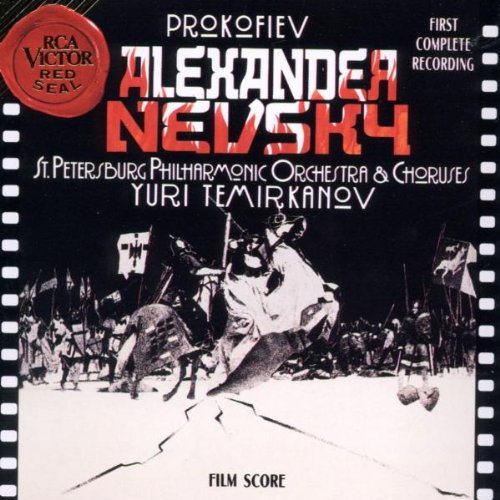
Respecto a la reconstrucción de la partitura completa editada en 1995:
Composition history
In 1987, orchestrator William Brohn created a version of Alexander Nevsky that could replace the widely derided original soundtrack in showings of the film accompanied by a live symphony orchestra. Producer John Goberman provides the following details concerning the genesis of the Brohn version:
"[Prokofiev] had orchestrated his score for a small recording studio orchestra, intending to achieve orchestral balances through miking techniques... However, partly because of Prokofiev's intent to experiment with the new soundstage recording techniques, the soundtrack for Alexander Nevsky is a disaster. Ironically, the best film score ever written is probably the worst soundtrack ever recorded. The intonation of the instruments and of the chorus is sad, and the frequency range is limited to 5,000 Herz (as opposed to an industry standard of 20,000 Hz). This in the period when Hollywood was turning out Gone with the Wind and Disney's Fantasia.
[...] In 1986, realizing that the Cantata contained virtually all the musical ideas of the film, I considered the possibility of overcoming the limitations of the original soundtrack by finding a way to perform this most monumental of all film scores with a full symphony orchestra and chorus accompanying the film in the concert hall. Crucial to the approach was that in the Cantata we had Prokofiev's own orchestration. If we could work out the technical issues, we could achieve a completely authentic re-creation of the film score which would allow audiences to hear what Prokofiev heard when he saw the magnificent images created by Eisenstein. I engaged the brilliant orchestrator (and my good friend) Bill Brohn to use the cantata to re-create the film score, both of us committed to the authenticity of the project from the beginning.
[...] So here, more than 50 years after the conception of Alexander Nevsky, we can witness the extraordinary visual imagination of Prokofiev captured in a soundtrack recording of what is probably the greatest film score ever written, in the authentic and unmistakable musical hand of its author."[18]
At the time the Brohn version was written, Prokofiev's original manuscripts of the film score were unavailable for study. Brohn transcribed the score, using the orchestration of the cantata as a model. Music not present in the cantata was transcribed by ear from the film. With special attention paid to tempos a 1993 recording of this version was matched to a new edition of the film, which was released in 1995.
Although the Brohn version is not technically the film score as composed by Prokofiev, it is a brilliantly successful substitute for the original soundtrack for live performances by a full symphony orchestra accompanying showings of the film. There is little in the arrangement that is not by Prokofiev. However, it is more accurate to say that this arrangement is a "hybrid" of the film score and the cantata, allowing the audience the opportunity to enjoy the film score cues using the expanded sound values of the cantata.
Vamos, que es la ideal a la hora de adquirir. En cuanto a orquestaciones e instrumentación tienes la mayor espectacularidad e intensidad de la cantata, pero también z toda la música de la película, incluyendo el preludio que finalmente se desechó incluir en la misma.
Si, la edición original de 1995 está descatalogada, cómo bien dices, pero se remasterizó y reeditó en
2004, y está disponible en los distribuidores habituales además de en los principales servicios de streaming.
Hala, te dejo enlace de
Amazon España,
13 euros vale. ¡Sólo queda 1 en stock, (aunque vienen más en camino, tranquilidad) compralo rápido!
https://www.amazon.es/Alexander-Nev...d=1462618700&sr=8-2&keywords=alexander+nevsky
De nada.




 .


 ? ¿Pues dónde la pones?

 Exacto, la película es meh, pero es un Broughton, ¡¿a quien demonios le importa la película?


 ? Y es una película que me encanta...
 ...?


 ..?

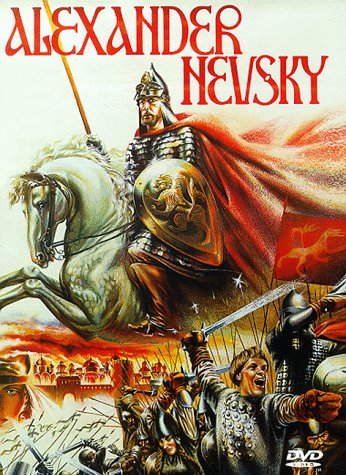

 ), recuerdo que con motivo del reestreno en algunas salas de la película a mediados de los 90, varias publicaciones recomendaron la edición (completa) de la banda sonora de Prokofiev, editada por el sello RCA en 1994:




 sudor, otro más) ¿qué opinión te merece El tábano de Shostakovich?